Those who follow matters surreal or Czech or artistic closely might be aware that there is a major Toyen retrospective currently on view in Prague. It's called, bilingually, Toyen: Snící rebelka / Toyen: The Dreaming Rebel, and it is curated by Anna Pravdová, Annie Le Brun, and Annabelle Görgen-Lammers.
Naturally, back when the show was in the planning stages, there was no reason to imagine that a global pandemic would hit a year before the opening and still be afflicting world health and world travel in 2021. I hate to think how the curators and their colleagues must have agonized during the past year, wondering whether the show would indeed open on time in April or what. Publishing a book during a pandemic is stressful enough, but the uncertainties of book launching and promotion certainly pale in comparison to the anxieties surrounding putting together a large multi-venue exhibition.
Fortunately, the show did open, but with very limited attendance allowed due to health restrictions. I spent most of my summer break waiting to see if the Czech Republic would let in American tourists, and as soon as I got the good word, I was booking my flight. I was afraid that if I didn't book right away and leave as soon as possible, the pandemic might go wild again (which it already pretty much has, although I think it is still possible to fly from the US and be allowed into the Czech Republic).
My stay in Prague was extremely short and coincided with some insanely humid weather (cool temperatures that were nonetheless scarcely bearable due to the humidity) which I'm sure connected to the terrible rains and flooding in western Germany. However, I did get to see the exhibition twice, as well as going to a few other things and meeting up with a very small number of people. I can also report that although the Czech Republic has its anti-vaxxers, the population of Prague was very diligent about masking in indoor spaces, which was a relief after so much neglect of masking back in the US.
In any case, the exhibition was absolutely gorgeous, beautifully displayed. Totally worth seeing more than once! Of course, as a Toyen scholar I did have some criticisms, which you can learn about in my review of the show for the CRAACE website's blog (CONTINUITY/RUPTURE: ART AND ARCHITECTURE IN CENTRAL EUROPE 1918-1939), but for the most part they don't relate to the experience of viewing the art.
So if you can see this show when it moves on to Hamburg or Paris, by all means do so. I also heard (long ago) that it would come to Chicago, but I haven't been able to verify that that is still going to happen. Let's hope so.
National Gallery Prague, Waldstein Riding School, 9 April to 22 August 2021 (sold out)
Hamburger Kunsthalle, 24 September 2021 to 13 February 2022
Musée d’Art Moderne de Paris, 25 March to 24 July 2022
Showing posts with label museums. Show all posts
Showing posts with label museums. Show all posts
Friday, August 13, 2021

Saturday, April 24, 2021
Museums as Agents of Change
I'm so pleased to see that my friend Mike Murawski's book Museums as Agents of Change: A Guide to Becoming a Changemaker will be available Monday from Rowman & Littlefield / American Alliance Of Museums. In this book, Mike looks at how we, as individuals, can expand the work of museums to live up to their potential to serve as agents of change--how they can bring people together, contribute to local communities, and change people’s lives. He asks how can we better recognize the meaningful work that museums are doing to enact change and how can we work together to build a stronger culture of equity and care within museums. Such questions are increasingly vital for all museum professionals to consider, and are also important questions for all of us as community members.
Museums as Agents of Change is available in hardback and paperback, and soon also as an e-book.

Museums as Agents of Change is available in hardback and paperback, and soon also as an e-book.
Wednesday, February 24, 2021
The Museum Age in Austria-Hungary
And another intriguing book comes to fruition! The Museum Age in Austria-Hungary: Art and Empire in the Long Nineteenth Century, by Matthew Rampley, Markian Prokopovych, and Nóra Veszprémi, has just been published by Penn State University Press. This study of Austria-Hungary's public art museums considers them in the context of European museums and collecting, as well as looking at their place in the Empire's complex cultural politics. From the installation of imperial art collections in the Belvedere Palace in 1784 to the dissolution of Austria-Hungary after the First World War, and focusing on institutions in Vienna, Cracow, Prague, Zagreb, and Budapest, The Museum Age in Austria-Hungary traces museum culture over the long nineteenth century.
For more info, and to order a copy, click here.
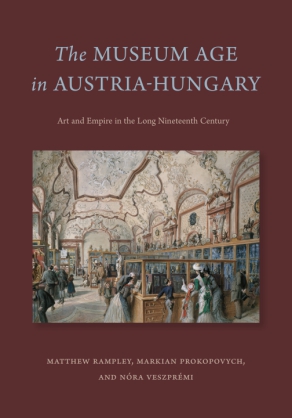
For more info, and to order a copy, click here.
Monday, March 16, 2020
Upcoming Toyen Exhibition!
Here's a bit more good news that I didn't get around to posting earlier. Back in November, when I served as discussant on a panel of papers about Toyen at the annual ASEEES conference, Anna Pravdová revealed that the National Gallery in Prague is preparing a major Toyen show for 2021 that will travel to France and Germany. Magnetic Woman will have just come out, so it should be possible to stock copies in the museum stores.
And, further exciting news... last month when I was in Chicago for the annual CAA conference, staff from the Art Institute of Chicago (which, by the way, will be closed March 14-27 for safety) told me that they had just arranged to bring the show to Chicago!
During my visit to Chicago I not only got to catch up with various friends and colleagues, but also saw the Art Institute's exhibition on Bauhaus weaving just before it closed.
Monday, July 23, 2018
Cool Summer Drinks, Czech-style
It's hot out and the thought of a cool drink is very appealing. But let's not think in terms of soft drinks or plain water (although the Czechs do have a cola called Kofola and they do drink lots of water, particularly of the sparkling variety). And let's also leave out beer, because we all already know the Czechs are famous for their beer, right?
Here's a popular option: Limonada. This term does not mean lemonade in the American sense, although lemonade is one possibility if we're talking about limonada. Basically, to make limonada you need carbonated water of some sort and fruits and/or vegetables. For instance, you could mash some red currants in a tall glass of that water.
The best limonada I had this summer was at the cafe in the Veletřní palác (which is the modern and contemporary art museum). In a tall glass, slice lots of cucumber. I'm not sure quite how much--that's up to you--but it was best when thinly sliced. Add a slice or two of lemon or lime, perhaps a little sugar (not much though) and perhaps some mint leaves. Stir it around and mash the cucumber slices a bit. If you wish, add ice cubes. Serve with a spoon or fork for the slices. It's just divine.
Monday, May 28, 2018
Prague-Brno Train Travel Gets Trickier
On Saturday I headed for Brno on a day trip to go to a museum or two. In the past I've often taken the yellow Student Agency bus, which is a great option--very comfortable, with drinks and movies. On the other hand, if traffic slows to a crawl between Prague and Brno, there's nothing much the bus driver can do about it.
And, it looked like the museums I wanted to go to were a very simple walk from the Brno train station, so this time around I opted for the train. I looked up schedules on idos.cz, wrote down the most promising few, and set off for the station to buy my return ticket and go.
My day in Brno was pleasant, if a bit on the warm side. I saw some art, although the paintings I had gone especially to see were not on display, being removed for conservation or loan. (Right, the signs didn't specify which, so I have no idea whether these works are on display in some other city or secreted in a basement lab!) I also visited Brno's design museum, a gorgeous building inside, which turned out to be entirely taken over by a design biennale. I wanted to see that, but didn't find it as interesting as I had hoped.
I headed back to the train station, where my notes indicated I could catch the 5:09 back to Prague. The return ticket I had purchased was valid for trains going through a range of towns--there was only one town listed as not valid. Pardubice was on the valid list and the 5:09 train went via Pardubice, so I climbed aboard, saw a window seat that wasn't marked reserved, and planted myself. A young woman then sat next to me, the train started, and I began looking at the scenery.
A young man arrived with bottles of water and, to my mild surprise, asked for my ticket. (Conductors and refreshment purveyors are not, in my experience, the same person.) He informed me, pleasantly enough, that my ticket wasn't valid on this train because my ticket was from Ceske drahy whereas this was a Regiojet train.
Well, this was news to me because in my experience Ceske drahy sells the tickets for all train trips in the Czech Republic. Never mind whether the train originally comes from Germany or Hungary, if you buy your ticket in the Czech Republic, you're buying from Ceske drahy. But apparently Regiojet, which is part of the same company as Student Agency, has somehow obtained the right to run its own passenger trains that require purchase through that company.
I have mixed feelings about this. On the one hand, Student Agency and Regiojet are very good at what they do. Their buses and trains are new and comfortable and not particularly expensive. And despite my ticket not being valid, I was left in peace the whole way to Prague. (I was going to get off at Pardubice and change to the next Ceske drahy train, but when we got to Pardubice the woman next to me was sound asleep and didn't respond to my voice or nudges, and her tray table was down, so I figured it wasn't worth it to shake her awake.)
On the other hand, I really don't like the idea that now the traveler has to worry about multiple companies and whether the ticket is good for the next train. The UK broke up their train system into a gazillion different carriers, and while their trains are nice too, it can be difficult to figure out just how to get to your destination. It's my impression that in the UK, it's at least divided up by region, but none of the companies seem to be able to provide any information about anyone else's train and so when I wanted to take the night train from London to Arbroath, I was unable to determine whether it had couchettes or if so how I would reserve one. (Perhaps I was incompetent, but I did spend quite awhile once fruitlessly trying to find out more about the Caledonian and eventually just dozed in an ordinary seat.) In the case of Ceske drahy and Regiojet, the trains are in direct competition on the same tracks.
Just when you think you know (mostly) how something works, you learn you don't after all.
Thursday, May 24, 2018
Image Acquisition Continues
This year's Czech trip has several purposes--among which are doing research for new projects and seeing friends--but the more pressing project is, of course, image acquisition for Magnetic Woman. I knew when I began that image acquisition for art history books generally takes quite a bit of time and money, but each book has different needs and I didn't really have a clear sense of where my own time and money would end up going. I did know that I had taken a lot of photographs myself of Toyen's book illustrations, which meant that while I'd still have to pay copyright clearance on those, at least I wouldn't have to pay for the photos.
Yes--payment is usually a two-step process. First you get a photograph (these days typically a hi-res digital image) of the work, which can be anything from free to hundreds of dollars per photo, and then later, if the work is under copyright, you pay to clear copyright. In other words, you tell the copyright clearance people what you want to use this image for, how big, whether in color or b&w, etc., and they tell you how much it will cost.
An area where I've made nice headway since coming to Prague is that of getting photos of Toyen and her associates. I knew that the Památník národního písemnictví (PNP), which although an archive of Czech literature nonetheless is a major repository of art-related materials, had some of these photos. I also knew that the design museum (UPM) had purchased Jindřich Štyrský's photos, which included at least one of Toyen. I've worked with both of these entities before and am pleased to say that both responded very appropriately and professionally to my inquiries about photos and that I have now paid for and received most of what I requested. (One photo still has to be scanned by the PNP, and there are one or two artworks I may also request from them which are handled by the art side rather than the literary side.) This is all good and a great relief.
There remain some photos I'd like to get--photos of photos, that is--but I'm not sure who has them. Usually publications provide individual credits of who something belongs to, but some of these photos have been published without a specific credit, which is unhelpful.
Acquisition of photos of paintings remains even more difficult than I had anticipated. I knew that it probably wouldn't be easy to locate photos of privately held works, but it never occurred to me that several museums and galleries would simply not respond to emails. Kudos, therefore, to the museums that have already provided images, whether free or fee!
Saturday, May 19, 2018
A Small Progress Report
These last few weeks have been a busy time for me. As usual, I have several projects underway, but I also had to get ready for this year's research trip to Prague and then get settled in.
Image acquisition for Magnetic Woman is moving along, although never as quickly as I'd like (each month I hope that I will finally wrap up this phase of the book!). Just prior to leaving the US, I discovered that the library of the Art Institute of Chicago has some of what I was looking for, so I hurriedly made an appointment to go up there. In recent years, the Art Institute has acquired numerous examples of Czech modernist books and journals--they now have a real trove--and the librarians were very helpful. I was able to take my own study photographs of all sorts of things plus order reproduction-quality photos of some items for the book.
After arriving in Prague, I set out to obtain copies of photos of Toyen and other members of the Czech avant-garde. Quite a few have been published in the past, but not always with clear indications of their provenance. I knew, however, that the Památník národního pisemnictví (literary archive) would have some and that the UPM (design museum) would also be a good place to inquire. The Památník was able to offer me a selection of photos they had already scanned, plus when I went to their central depository in Litoměřice and rooted through Vítězslav Nezval's personal photos, I saw other interesting options. For the most part it must be said that Nezval's snapshots of his friends are small and not terribly clear, but I did find a more professionally done photo from an event that struck me as worth using in the book. Nezval's photo stash also included a set of entertaining pictures of him on an outing with Roman Jakobson, Jan Mukařovský, and a young woman who was very cozy with Nezval, and as Nezval, Jakobson, and Mukařovský all figure in my book, I was tempted to include one of these photos. However, there was not a specific one that was really quite right for my chapter, so with regret I passed on this even though I would have enjoyed showing that Mukařovský had a less serious side than one might gather from his scholarly work.
The UPM, meanwhile, is preparing a digital file of one of their photos for me.
So--there's progress, although I'm not happy about museums that don't respond to my inquiries.
Subscribe to:
Posts (Atom)