Showing posts with label observations. Show all posts

Saturday, September 24, 2022

Do You "Picture" Things You Read?

Perhaps you're one of those readers who vividly envisions settings and characters when you read. You might even rely heavily on the author's descriptions in order to do so, and feel cheated if there isn't considerable detail about characters' hair and skin color, about what's in their homes, or what kind of vegetation they encounter when hiking.

On the other hand, maybe you're one of those readers who skips past "tedious" description to get to the dialog. You might not even envision any of what's described, or have any expectation that you would truly see something in what we call your mind's eye.

Or, of course, you might be somewhere in the middle of these extremes.

These are all perfectly normal, but very different, ways of experiencing the written word--and life more generally. Humans experience mental pictures (or don't) along a spectrum that goes from seeing nothing at all (aphantasia) up to envisioning things as if they were watching an amazingly detailed movie (hyper-phantasia). The same sort of variation is true for mentally conjuring up sounds, smells, taste, and touch/movement, but it appears that the most study has been devoted to visualization and its lack. Indeed, study of any form of aphantasia or hyper-phantasia is a pretty recent phenomenon, because it's been only relatively recently that people seem to have begun to realize that what they themselves experience in terms of visualization or other imagined sensory experience isn't necessarily what their siblings or their friends experience. The internet is now full of people with aphantasia telling how surprised they were to learn that many people actually do see something in their mind's eye--that it's not just a figure of speech.

I don't have either aphantasia or hyper-phantasia, but when I first heard of aphantasia, I was deeply intrigued. Despite being an art historian, my ability to call up a visual image is extremely limited. I'm good at identifying works by artists I'm familiar with--I can easily walk into a room at a museum and start pointing at artworks across the room and tell you which one is by Romaine Brooks or Archipenko or Jacob Lawrence. But that doesn't mean I can summon up artworks in my mind in anything but the vaguest way. I have a general sense of what Matisse's Blue Nude looks like (horizontal, blue body, fairly abstract), but that's about as clear as I can get. I don't know whether her head is to the right or the left until I refresh my memory by looking at a photo of the painting.
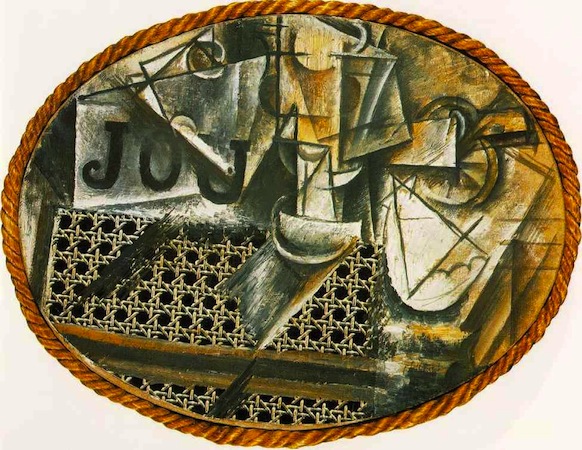
This led to a somewhat embarrassing moment in my PhD orals, in fact. We were discussing collage, and at some point Terry Smith, who was on my dissertation committee, expected me to remember what Picasso's Still Life with Chair Caning looks like. It wasn't unreasonable of him to expect me to know this work, because it actually is quite important in the history of collage. I did know that I was generally familiar with it and could probably identify it if I saw it, but at that point in my studies I hadn't fully realized its historical significance; to me it was just one of many works that Picasso and Braque made around 1912 that combined painting and collage or assemblage. But Terry seemed to think he could gradually lead me to visualize the thing, which I really couldn't do. Even now, after having taught this artwork many times, the best I can do is summon up a horizontal oval framed by a piece of rope. I'm aware that Picasso collaged a print of chair-caning onto the thing, but although I can sort of recall the pattern of the chair-caning, I can't attach that to the oval framed by the rope, or recall just what Picasso painted onto the print except that it was the sort of standard table-top items Picasso liked to put in his still lifes at that period in his career. So... probably a newspaper and a bottle or glass or cup and maybe a plate. This kind of detail just does not remain in my visual memory.

Likewise, while I have a clearer visual recollection of Girodet's painting Endymion, which I've also often taught and which is the basis of the more psychedelic-looking figure on the cover of In Search of the Magic Theater, I couldn't tell you offhand where the dog in the painting is located. I get a fairly good mental image of the overall painting--it's dark, with Endymion reclining across it and Cupid entering from the upper left, but while I know the dog is in the lower part of the painting, is it to the left or the right? I just can't see the dog at all. (Granted, the dog is not a very important figure, but most pictures of the sleeping Endymion do include his dog and so does this one.)

As you might guess, therefore, writing visual description is not something I'm uniformly good at. It's not that I can't do it, but I often have a very hard time recalling enough about things I want to describe.

Maggie Giles, another of the 2022 Debut novelists, is a writer who has full-blown aphantasia. She doesn't see anything at all in her mind's eye. She discusses that and other aspects of her writing in this Instagram Live interview with Dara Levan. Among the things Maggie says about her writing process: first, she writes a draft that emphasizes dialog and plot, and then she goes back and fills in description, often with the help of photographs.

What about the reader's perspective? What do readers want?

I have read that readers want and expect lots of visual information because they rely on this to form their mental movies of novels. I daresay some of them do, but I also have to wonder whether some of those readers simply lack imagination, that they can't come up with their own mental movie without a ton of help from the author. I myself enjoy rich description but it doesn't produce any sort of mental movie for me, and I don't miss rich description if it's not there--I form my own impression of characters and setting even if it's not particularly visually rich or detailed.

I've also read that readers with aphantasia may find detailed description a waste of time. Does this mean that those people not only can't picture things but don't get any sense of place or costuming or whatnot from the descriptions given? After all, many people with aphantasia are actually visual artists, so it isn't like having aphantasia means that a person necessarily lacks visual skills, they just don't see things in their mind's eye. I'll bet some of those artists with aphantasia could come up with illustrations for what they've read. And--a different question--are Ivy Compton Burnett's novels especially appealing to readers with aphantasia because they consist almost solely of dialog and are nearly devoid of visual description? Inquiring minds want to know!

I haven't even touched upon aphantasia and hyper-phantasia in senses other than the visual. All of this varies enormously from person to person. For instance, I can have extremely strong sensory recall of some kinds of touch and motion, but that doesn't mean that if I read about velvet I actually feel like I'm touching velvet. I can imagine touching velvet if I make the effort, but I don't have any emotional connection to touching velvet, so I'm not much inclined to imagine touching velvet, whereas I have a strong emotional connection to the memory of my late Rex rabbit Mikko (aka Mr. Velvet-coat) and can instantly recall the sensation of his fur.

Want to learn more about aphantasia? Check out www.aphantasia.com. The Aphantasia Network was founded by Tom Ebeyer and has lots of interesting information on the subject.

Thursday, July 7, 2022

Thoughts on BookTok

Jane Friedman, publishing guru (and I'm not saying that sarcastically because she really is, and is fabulously informative), notes on Instagram:
BookTok has helped authors sell 20 million printed books in 2021, according to BookScan. So far this year, those sales are up another 50%. NPD Books said that no other form of social media has ever had this kind of impact on sales. As a result, publishers are being influenced more than they’re doing the influencing, according to Emma Quick, senior marketing manager at Bonnier Books UK. As is often observed, BookTok is full of readers’ emotional, visceral reactions to books. Strong reactions require provocation: plot twists that make you angry enough to throw the book across the room, or endings that make you bawl your eyes out.
On the one hand, I think it's great that readers become passionate about books and want to promote then on TikTok videos. I mean, if you're an author who appeals to the BookTok demographic, that's likely to result in lots of sales even if you never once go near TikTok.

On the other hand, TikTok's demographic is heavily teen and under-thirty--a limited slice of the readership pie. What's more, even among that age group not everyone wants to read a steady diet of books that prompt sobbing and book-throwing. Even a reader who enjoys a quiet tear over a sad moment in a book may not want to weep copiously or feel buffeted by hurricane-quality winds of emotion.

And so, while I'm pleased that lots of teens and younger adults are reading and loving to discover and discuss books, I won't be so pleased if publishers decide that they need to base their acquisition strategies on what makes fifteen-year-old girls the most histrionic. We already have way too much of a tilt in US publishing toward insisting that novels begin at some exciting point and escalate from there. Again, nothing against novels that do this, and nothing against highly emotional teen readers, but the world of books and readers encompasses so much more. Just as it's good to have books that excite strong feelings, it's also good to have books that are calm, cozy, or thought-provoking. Both thinking and feeling are important, just as rest needs to balance intense activity.

As a side note, I wonder whether Goethe's The Sorrows of Young Werther (infamous in its day for prompting numerous suicides) or the works of Dostoevsky (also known for their emotional effect) are currently inciting any BookTok videos.
The Reader of Dostoevsky, 1907, by Emil Filla

Saturday, April 30, 2022

It's Independent Bookstore Day!

I'm not great at keeping track of obscure holidays and festivals, so I was thrilled to learn of Independent Bookstore Day before the actual day. And yes, it's today, April 30!

My city is sadly devoid of independent bookstores that sell new books for general audiences. Yes, we do have a Barnes & Noble (we used to have two but one lost its lease, which is a crappy reason for bookstore closure and I gather that Barnes & Noble seeks a new location). We also have several stores devoted to used books, which is a wonderful thing. But there is no independent bookstore with a quirky, individual mix of old favorites and exciting newly published titles, and this is a sad thing for the community. It also eats at me as I try to determine where to celebrate my novel's launch in just one month. Will it work out to launch at Barnes & Noble? (Maybe, but they're just now trying to remember how they used to do in-person events.) Could I launch at the library or my local cafe instead? (Maybe, but neither has much of a history of author events to draw in people who don't know me.)

And so I say to you, if you have a local independent bookstore, or more than one, go forth and visit them today. Let them know you appreciate them.

Thursday, April 14, 2022

Magnetic Woman Expands its International Reach

Through the magic of Worldcat, and the Polish NUKAT (Union Catalog of Polish Research Libraries), I see that a copy of Magnetic Woman can now be found in Łódź at the Biblioteka Uniwersytetu Łódzkiego!

This is in addition to library copies in the British Isles (Maynooth, Fife, London), elsewhere in continental Europe (Paris, Leioa in Spain's Basque country, Barcelona, Lausanne, Berlin, Stockholm, Munich, Heidelberg, Würzburg, Zürich), and Wellington, New Zealand. This is in addition to copies at many US university and public libraries and one in Montreal.

While I've sent copies to a good many Czech institutions, apparently none of them report to Worldcat.

If your library doesn't yet have Magnetic Woman, do ask them to order it! You can point out that it is a prize-winning study of a fascinating gender-ambiguous surrealist. And if you've read it, please consider reviewing it, whether for a scholarly journal or on Amazon or Goodreads!

Spread the word about Toyen and Czech surrealism!

Monday, March 28, 2022

Still Available for Review on NetGalley!

Authors in the age of social media often find outselves feeling a little like the proverbial broken record as we keep mentioning our books. But it isn't (usually) because we're vain or can't think about anything else. In today's hyper-saturated publishing world, where far more books than ever before are published, it's simply necessary for us to do everything we can think of to bring our books to the attention of potential readers. Our publishers do some of that work (if we're lucky), but they generally have quite a few books to publicize all at once.

And so, once again, let me point out that my novel In Search of the Magic Theater--a tale of music, theater, generational tensions, strong women, and a bit of romance--is currently available for pre-publication review on NetGalley. Reviews that appear prior to publication, whether in Publisher's Weekly, Kirkus, NetGalley, Goodreads, or elsewhere, help readers learn about books they may be interested in, which encourages pre-orders, which encourages more support from publishers.

If you read and review via NetGalley, this post is for you!

Wednesday, December 29, 2021

Take Dada Daily for Best Results

"The times are dark and hard, and I know no better means to overcome the chaos of the day than reading about Dadaist appearances.” Rudolf Lothar, “Der Dadaismus.” Neues Wiener Tagblatt, 3 October 1918.

Sunday, July 4, 2021

50 Classic Short Novels I've Read (or Not)

This morning, waking up early to cough a week or so after I thought I'd shaken a minor unidentified ear-nose-throat virus (it began in my ear), I chanced to see what sort of news my smartphone had to offer. I try to avoid doing this, but like many things in life, it's an addictive practice and admittedly provides me with a fine array of news not just about covid-19 and the ex-president, but about Stonehenge, ancient hominins, camping, fungus-infected ants preserved in amber, and advice columns by at least three different people.

Of late it's been offering up a lot of literary and writer-oriented stuff, and so this morning I found myself devouring a list on Lithub of short novels (under 200 pages) written before 1970.

Now, although I am trying very hard to read fiction by current authors, I'm more the kind of reader who goes for underappreciated gems that have nonetheless passed the test of time. It's no surprise that I'm a historian of modern rather than contemporary art. Anyway, while as the list-maker (Emily Temple) admits, it's sort of a white-male-dominated list, it's still an exciting list and I was thrilled to see so many familiar and new titles.

I'm going to break up the list into what I've read, what I've meant to read (or at least knew of), and what I've never heard of.

Read
Adolfo Bioy Casares, The Invention of Morel: The list began with this! I'm stunned. I read this just after graduating from college, when I was interning at an experimental theater and checking out books from the Mill Valley public library. I read a lot that summer, most of it pretty famous (from Joyce's Ulysses to all of Raymond Chandler).
Arthur Conan Doyle, The Hound of the Baskervilles: Not sure how old I was when I read this. High school? Junior high? Grade school?I read all of the Sherlock Holmes stories at least once. Probably ought to read them again.
Italo Calvino, The Cloven Viscount: Ah, what a delight. I discovered Italo Calvino just before starting college, thanks to (of all things) a book review in Time. I really need to reread this. It's been too long. I love Italo Calvino.
Richard Brautigan, In Watermelon Sugar: Did I read this in high school or in college? I read a fair amount of Brautigan and Kurt Vonnegut all around the same time. It's what we did in the 1970s.
Thomas Mann, Death in Venice: First read this in 1980, for a class. I read it while sunbathing nude in a meadow, which I put into the pandemic novella I wrote last year because such things belong in fiction. Of course, it could be argued that I should have read it at the beach instead. It's the kind of thing I would read at the beach if I hung out at beaches. Grim, diseased, with long sentences.
Shirley Jackson, We Have Always Lived in the Castle: Probably read this in high school. The Haunting of Hill House was the Shirley Jackson I read many times as a child, but I read other Shirley Jackson books in high school.
Françoise Sagan, Bonjour Tristesse: I read this in junior high or high school, probably the latter. My recollection of it is not all that clear; time to reread.
Franz Kafka, The Trial: First read this in high school, when I devoured Kafka.
Djuna Barnes, Nightwood: I believe I picked this up in or just after college. Another of those curiously influential books twisting my mind.
Jean Rhys, Wide Sargasso Sea: I love Jean Rhys, but this is my least favorite of her books. I've only read it once. I did give my mother a copy since she loved Jane Eyre, but I have no idea what my mother thought of this take on the characters.
Muriel Spark, The Girls of Slender Means: Guessing that I first read this is my twenties, when I read practically every Muriel Spark novel that then existed (and which all, in the library copies, showed Spark in what seemed a bizarrely outdated and extravagant style of hair and makeup). These days I read this and several other Spark novels frequently and do not read certain of the others at all.
F. Scott Fitzgerald, The Great Gatsby: I suppose I must have first read this in high school, back when I was somewhat baffled by the idea of someone's voice sounding like money. Like coins? Like paper money? I wasn't sure.
Vladimir Nabokov, Pnin: Curiously, this is one I only read quite recently, and enjoyed it. I haven't read all that much Nabokov. I always enjoy The Real Life of Sebastian Knight; I liked Lolita well enough back in my teens or twenties but found it rather horrifying more recently; I was not that wild about Ada.
Anthony Burgess, A Clockwork Orange: Read this in college, or possibly high school. I know I saw the movie in college. The invented slang intrigued me.

Meant to Read Someday, or Knew Of, or Read Others by the Author
John Steinbeck, Of Mice and Men: Never got around to this; read The Red Pony and The Grapes of Wrath.
George Orwell, Animal Farm: Yeah, I know I should. And it almost seems like maybe I did.
James M. Cain, The Postman Always Rings Twice: I am pretty sure I somehow missed this.
Nella Larsen, Passing: Knew of this because I read Jessie Redmon Fauset's Plum Bun, which gets discussed in relation to Passing.
Albert Camus, The Stranger: Somehow never got around to it.
Kate Chopin, The Awakening: Started it in high school, apparently got distracted and didn't finish it.
Leo Tolstoy, The Death of Ivan Ilyich: I have no idea why I haven't read any Tolstoy yet. Wait, I did read something he wrote on art, thinking I might assign it to students.
Christopher Isherwood, A Single Man: I read an awful lot of Isherwood in high school, but not this one. Saw the movie.
Fyodor Dostoevsky, Notes from Underground: Read a lot of Dostoevsky in junior high, but I don't think this was among them. Could be wrong.
Anna Kavan, Ice: I've read other works by Kavan, but never heard of this one.
Jean Toomer, Cane: I've known who Jean Toomer was for ages, but never looked for or run across his books.
Knut Hamsun, Hunger: Ought to read it, haven't yet.
James Baldwin, Giovanni's Room: Unsure why I haven't ended up reading any James Baldwin yet.
Willa Cather, O Pioneers! One of those books my mother read growing up that I haven't gotten to yet. I did read at least one Cather short story long ago.
Herman Melville, Billy Budd. Didn't realize this was short. Moby Dick has been on my to-read list.
Thomas Pynchon, The Crying of Lot 49: Not sure why I didn't read any Pynchon back in my twenties.
George Eliot, Silas Marner: This always sounded like something that might bore me.
Truman Capote, Breakfast at Tiffany's: This might be a nice antidote to In Cold Blood, which I've read at least twice. Saw the movie on an airplane shortly before the pandemic, oddly enough.
Chinua Achebe, Things Fall Apart: Have heard this is good (I mean, before reading the LitHub list).
N. Scott Momaday, House Made of Dawn: Know of the author, haven't yet read him.
Philip K. Dick, Ubik: Read a few others by Dick and mostly enjoyed them; not this one yet.
Clarice Lispector, Near to the Wild Heart: Read one of her books in my twenties and have never run across any others. The one I read was destroyed by salt water and I'm baffled as to which one it was.
Zora Neale Hurston, Their Eyes Were Watching God: Keep meaning to read this...
Edith Wharton, Ethan Frome: One of those books that I suspected would be dull and so have not read.
Joan Lindsay, Picnic at Hanging Rock: Saw the movie, didn't know it was based on a book.
Angela Carter, The Magic Toyshop: OK, I know I should read Carter's fiction as well as her nonfiction...

Somehow Completely Off My Radar
Juan Rulfo, Pedro Páramo
James Weldon Johnson, The Autobiography of an Ex-Colored Man
J.G. Ballard, The Drowned World
Kenzaburo Oe, A Personal Matter
Yasunari Kawabata, Snow Country
Robert Walser, Jakob von Gunten
Leonard Gardner, Fat City
Chester Himes, If He Hollers Let Him Go
Charles Portis, Norwood
Barbara Comyns, Who Was Changed and Who Was Dead

Readers are invited to add to the list (not doubling up on authors). A quick look at my shelves didn't offer much. I was surprised that my copy of Heinrich Böll's The End of a Mission was slightly over 200 pages, and I forgot to check if it was pre-1970 (it is). Giorgio Bassani's The Garden of the Finzi-Continis is just under 200 pages. I lost a lot of books to salt water, long ago.

Wednesday, June 2, 2021

Myths and Rules About Writing

Aspiring writers, and even experienced writers, often look for advice on how to write better, more productively, more salably, and so on. This is natural and on the whole a good thing. It's a major way of learning to avoid pitfalls and not reinvent the wheel, for one thing.

At the same time, it's important to know to take a lot of this advice with a grain of salt. Just because something is often true, or works for many writers, doesn't mean it's always true or works for all writers.

On Sunday a group of us were on Zoom talking about a little of this. My friend Dirk van Nouhuys mentioned the Odyssey as something he had enjoyed in childhood, and observed that, in contrast to what we're told a protagonist should do, Odysseus doesn't change. He doesn't even look all that different after ten years fighting in Troy and ten years finding his way home--his dog recognizes him. Yet we always hear that the protagonist of a short story or novel must change. Well, this set us to thinking of other major works, or at least famous works, in which the protagonist doesn't change. Voltaire's Candide doesn't really change. It didn't seem like don Quixote did either. Nor Becky Sharp in Vanity Fair. In more recent fiction, people noted that Sam Spade, Hercule Poirot, and Miss Marple don't change, which suggests that in series mysteries, change is optional for the detective-protagonist and has become more common over time. Now, of course, externals do change in all of these works, so perhaps we can figure that in Western fiction, something has to change, even if not the protagonist. I'm not sure that change is necessary in some of the nonwestern traditions, but I don't know enough about, for instance, Ojibwe narrative tradition.

In addition to asserting that the protagonist must change, people also often exhort us to "show, not tell" and to make sure to throw plenty of obstacles and complications into a novel. While these prescriptions are not bad advice, and can be very useful to follow, they certainly aren't ironclad rules for creating good fiction.

In the realm of advice on process, again there are various prescriptions that sound good but aren't always as important as you might think. One of these is the notion that a writer must write every day. Sounds good, doesn't it? I've never paid a lot of attention to this advice since I do write most days, in some way or other, but Tim Grahl presents a good argument for a different way of approaching how often and how much to write. Basically, he suggests that writing to complete a project can make more sense than fretting that one didn't happen to write for a while. I'd add to this that the beginning writer does need to write a lot, and frequently, because that's how one learns one's craft, but--as one of the commenters on Grahl's post notes--some of our writing is in the form of emails, blog posts, tweets, journaling, and the like, which also counts to some extent. It may not move us along the path of finishing articles, stories, or books, but it's keeping us in the habit of putting words together for ourselves and others to read. I sometimes go for months (usually during the academic year) without getting much written on anything that has no deadline, but while this annoys me, it doesn't worry me, because I know I'll get back to my various writing projects and over time they'll get finished.

Which rules do you find over-emphasized about writing?

Monday, April 19, 2021

How Do Libraries Get Books?

Have you ever wondered what goes on behind the scenes at libraries--how purchasing choices are made and how books, especially e-books, come to be available? Author Maggie Lynch writes about The Importance of Library Distribution on her blog and notes that with the pandemic, libraries have adapted to changes in demand by providing stronger e-book offerings. As a reader who waited until the pandemic to get a Kindle, I can attest to my public library's growing interest in e-books!

Now, speaking of e-books, you may wonder whether Magnetic Woman is available as an e-book. The answer is, unfortunately, no. Rights for the art for e-book editions would have been even more expensive than what I had to pay (that's me, the author, not my publisher!) for print rights. Besides which, do you really want to read an art history book on a screen if you can read it on paper? Probably not, although I do think it would be nice to have a copy handy on an e-reader for travel.

Monday, March 15, 2021

How Quick a Writer Are You?

Writers both new and experienced often bemoan the speed at which they write. People have, of course, a wide range of preferred times and places to write, and approach their work in many different ways. Still, most of us would like to accomplish more than we actually do, especially those of us who have lots of ideas for new projects. Are there effective ways of getting our writing projects done, especially our books, more quickly?

I myself know that I'm capable of writing a book in a short period of time, because I've done it--I wrote In Search of the Magic Theater in three months, during which time I was also completing my PhD and teaching. Admittedly, that's not counting the fact that I first had the idea for it about ten years before I wrote it, and that I'd written a few pages some years prior to writing the whole book. In other words, I had thought about it some ahead of time--but not really very much, because I was in grad school for most of that period and there wasn't much mental space for either reading or writing fiction until I was close to graduation. So the fact that I wrote nearly every word of an entire and publishable novel in three months remains a fairly impressive thing. Years earlier I had written my first finished novel in about the same length of time, a murder mystery that I don't anticipate revising or seeking a publisher for. And in 2019 I wrote another novel in three months, followed by a novella in 2020 that took about the same amount of time. I wrote these three-month novels with a general goal of averaging 2000 words per day, which for me is not a difficult goal if I have a clear idea where I'm going.

Most of my book projects, however, are taking much longer. As in ten years or more. I completed one of those ten-year books in 2019 and have three others that I like to think I could finish if I had a good chunk of time for each. As in, maybe finish one each summer if my teaching and research don't get in the way. (After finishing my novella, I would have liked to finish one of the novels, but the rest of the summer went toward figuring out how to teach remotely in the pandemic, including creating a new course.)

One of the major pieces of advice for writers, at least in the academic world (but true for any writing), is Ass In Chair. Namely, you can't get writing done if you don't settle down and do it. Obvious, but especially important for those who don't enjoy writing, and many scholars don't. Even many fiction writers don't enjoy the writing itself particularly; they enjoy having written. However, I think most fiction writers do enjoy writing, at least much of the time. Why else would we do it?

My colleague Erin Flanagan over in the English department, who teaches novel and short story writing, found an interesting blog post about increasing our productivity, which I offer to you all, fiction or nonfiction writers of any sort. Rachel Aaron, also published as Rachel Bach, writes genre fiction series, so she has more deadlines than some of us do. She wasn't having much trouble managing 2000 words per day, but as a newly full-time writer with a series to write, she wanted to increase her productivity. After all, if she could write 2000 words a day before going to her job, couldn't she write 4000 words a day as a full-time writer?

At first she couldn't. And here I'd jump in to say that in my experience, writing a lot is something that, much like doing pushups or running marathons, you gradually work up to being able to do. Yes, you have to settle down to work, but at first you probably have to write in short increments and then build up how long you can work without getting frustrated or distracted.

Rachel says, "I gathered data and tried experiments, and ultimately ended up boosting my word count to heights far beyond what I'd thought was possible, and I did it while making my writing better than ever before." She began keeping records: "Every day I had a writing session I would note the time I started, the time I stopped, how many words I wrote, and where I was writing on a spreadsheet. I did this for two months, and then I looked for patterns." She discovered where she was most productive (for her, in a cafe with no wifi), and that if she had more than an hour available, she wrote more per hour than if she only had one hour to write (but that beyond seven hours, productivity dropped again). She also found the time of day that she was most productive, which was not the time she thought it would be.

This is something every writer can try--seeing when we are, individually, most productive and then making the best of that time. But Rachel also found two other major factors that improved her productivity. One, in fact, she discovered prior to studying when she was productive. This was to have a good idea in advance where she was going with a scene.

"I wasn't a total make-it-up-as-you-go writer. I had a general plot outline, but my scene notes were things like 'Miranda and Banage argue' or 'Eli steals the king.'" She knew the general direction and liked to let the characters take control. However, "this meant I wasted a lot of time rewriting and backtracking when the scene veered off course." She noted, "Here I was, desperate for time, floundering in a scene, and yet I was doing the hardest work of writing (figuring out exactly what needs to happen to move the scene forward in the most dramatic and exciting way) in the most time consuming way possible (ie, in the middle of the writing itself)."

Instead, Rachel began her writing sessions by jotting down notes about the scene she was about to write: "working out the back and forth exchanges of an argument between characters, blocking out fights, writing up fast descriptions." She says, "Every writing session after this realization, I dedicated five minutes (sometimes more, never less) and wrote out a quick description of what I was going to write. Sometimes it wasn't even a paragraph, just a list of this happens then this then this." This saved her from writing lots of text that went in the wrong direction and had to be cut or rewritten later.

This is not something I myself typically do when writing fiction. For one thing, I'm not usually (other than that mystery novel long ago) writing genre fiction. My characters don't usually have arguments or lots of dramatic action; often what goes on is more internal, and while I do a certain amount of productive, written speculation about what I might want to have happen, most of my best ideas happen in the course of actually writing. But while I don't usually have to do heavy revision of the kind many writers rely on (cutting scenes, turning two characters into one, changing point of view), I'm aware that my "quick" novels get written in a different manner, closer to what Rachel does, than my ten-year novels. My quick novels have more of a structure from the outset and I usually write them starting at the beginning and in the order of the chapters, ending with the end. My ten-year novels do have a structure from the outset, but it's a more open, fluid one. They're more likely to be a Bildungsroman, or some other less plot-driven form. My scenes aren't written in any particular order, I just will have an idea for a scene and know it goes somewhere in the middle. Gradually the scenes accrete and their order and transitions get worked out.

So although I'd like to write more of my novels more quickly, I'm not sure whether Rachel's advice about starting the writing session with quick notes will always work for me, but it should work for at least some of what I write, and should certainly help writers who like to outline in advance to some extent.

Rachel's third breakthrough was about enthusiasm. "Those days I broke 10k were the days I was writing scenes I'd been dying to write since I planned the book. ... By contrast, my slow days (days where I was struggling to break 5k) corresponded to the scenes I wasn't that crazy about." She began to focus on figuring out how to either get rid of the scenes that excited her less, or make them more interesting.

Again, since I write a different kind of fiction than Rachel, this isn't quite what I struggle with, but I have a parallel situation. The scenes that I put off writing aren't those that I find dull, really, but are more often those that I don't feel I know how to write yet--that I haven't researched something enough, or where I'm unsure how to do a transition. When wrapping up the ten-year novel that I finished in 2019, this kind of thing was my main focus, and often I found I could handle the problem by simply writing a few lines, a summary of what I wanted to say, and that was enough. Not every scene or transition needs to be fleshed out in detail.

What Rachel does not count here is the time spent plotting the novel and figuring out its overall shape. It's clear that she does this prior to writing the chapters, and this is something that can take significant amounts of time. I know I often think about a novel idea for years before I feel ready to start, even though I may not have more than a vague idea of the structure by the time I start. For me, having several simultaneous projects means that when I'm not focused on one in particular (writing that quick novel or finishing a ten-year novel), I'm never stuck because I can always work on a different project. I'm always curious how other writers structure their work and I'm not above stealing basic structures and plots.

Rachel says, finally, "There are many fine, successful writers out there who equate writing quickly with being a hack. I firmly disagree. My methods remove the dross, the time spent tooling around lost in your daily writing, not the time spent making plot decisions or word choices. This is not a choice between ruminating on art or churning out the novels for gross commercialism (though I happen to like commercial novels), it's about not wasting your time for whatever sort of novels you want to write." I agree with her. While I don't think all novels can be written quickly, I'm all for writing more efficiently.

After blogging about writing more productively, Rachel went on to write a book about her method, 2000 to 10,000: How to Write Better, Write Faster, and Write More of What You Love, which you can buy on Amazon for Kindle at a very reasonable price.

Thursday, January 7, 2021

It Was a Sad Day in US History

Yesterday's mob riot in Washington DC, which began with a peaceful but ill-informed protest by supporters of the current president, marks a tragic breakdown in social norms and shows the danger to our democracy that this president and would-be dictator has posed throughout his term of office. As others have noted, it is not a matter of rejoicing to have comparisons to the rise of Nazi Germany proved accurate. That Americans carrying Confederate flags and wearing clothing celebrating Auschwitz should break the Capitol windows to swarm in and threaten Congress, leave graffiti, and rummage through the desks of members of Congress, is a sad comment on our current situation but an unsurprising outcome of the lies and white-supremacist attitudes of this demagogue president and his enablers. These people left bombs for both Democrats and Republicans, and it is not surprising that one person was killed.

It is time to remove this president and heal our nation.

Saturday, August 22, 2020

Search-and-Replace Amusements

It recently dawned on me that by some fluke I had given the same name--Eli--to minor but significant characters in two pretty different novels. I'm not sure what prompted this--I've only met, I think, one Eli in my whole life and I didn't know him well at all. We worked for the same organization decades ago. So I haven't been naming characters in his memory, or with any particular thoughts about him beyond that he was proof of living Americans possessing this name. But I kind of like the name, so it worked well for my character Sara's presumed father in my forthcoming novel In Search of the Magic Theater.

However, the Eli character in the novel I wrote last fall isn't intended to be the same person, so as the name Eli isn't exactly as common as, say, Dave or Ben or Michael, I felt I really had to change this character's name. Not that I would never name another character Eli, but if I do, I want him to be entirely distinct and obviously not the same Eli. After some fretting and briefly considering changing him to Eliott (and I've had at least two friends named some spelling of this name), I settled on Ira. We'll see if that sticks.

I then had to do the search-and-replace, which is always fraught with danger. It's best to be very cautious running search-and-replace. And so here's what I found in searching the full document rather than going to the end where the character Eli actually entered the story...

People in this novel, especially the protagonist, are constantly feeling things. Note that eli in feeling! While the two narrators in In Search of the Magic Theater also have significant feelings, I'd be surprised if the word comes up quite as often in that novel. Their feelings are largely emotional, whereas the protagonist of the other novel experiences quite a few physical sensations as well.

The words religion and religious also came up a lot in my search for Eli. This was quite a surprise as religion doesn't play a particularly large role in the story. But maybe it plays a larger role than I had thought.

Believe and belief were very frequent. Not generally in relation to religion, but my protagonist does have her share of beliefs, and also disbeliefs, and characters say things like "Can you believe it?"

Relief and relieved also crop up a certain amount.

Delightful appears, but much less often.

Elicit, traveling, peeling, reliably, relics, evangelical, candlelight, celibate/celibacy, eligible, likelier/likelihood, canceling, reliance, delivering, and Queen Elizabeth I of England were the other Eli-containing words that appeared, most of them only once except for traveling, celibate/celibacy, and elicit. And no, the novel is not about celibate clergy nor is it set in the English (or any other) Renaissance.

This was kind of fun and enlightening, and very unexpected. And worth giving a try to even in fiction that doesn't need to change an Eli to another name.

Saturday, July 11, 2020

Index Submitted!

Just over a month ago, the page proofs for Magnetic Woman arrived. It was time for me to do an initial proofread (had any errors crept in during copyediting, or not been caught by the copyeditor?) and decide whether to pay the press for indexing, hire an indexer, or do the index myself.

I decided to do the index myself.

Why? Well, several reasons. First of all, it would save me money, and art books cost the author money for images and copyright clearance. My copyright clearance fees will soon need to be paid--Toyen and some of the other artists reproduced in the book are still under copyright. But also, I know my book well and I appreciate a thorough index. I'm one of those researchers who expects every mention of an obscure historical figure to show up in the index of a book so that I can glean whatever tiny tidbit of information about that person that might be offered there. Not every index is equally thorough, just as not every copyedit is equally thorough. As a former copyeditor and proofreader, I know that a publisher can say "Do a light copyedit" or "Do a heavy copyedit" on a book, and while some books only need a light copyedit, other books get light not because the author was meticulous with the English language but because fixing the author's clunky prose would be expensive and the book's audience will put up with clunky prose because they need the information. Likewise, a really thorough index takes more time and costs more (if you are paying an indexer, that is).

I am capable of being obsessive about thoroughness and getting things right. Not as obsessive as another member of my family can be (this member of the family is thanked in the book), because at a certain point I do say "The perfect is the enemy of the good" and quit. I knew that this somewhat obsessive tendency, along with my experience as a proofreader, would enable me to do a pretty competent job of indexing despite never having previously indexed a book. But I knew it would not be a quick job.

And so here I am a month later, having finally turned in my index. I've always appreciated what indexers do, but now my appreciation is magnified! The amount the press would have charged me to pay someone else to do the job would have been not all that much above minimum wage had the indexer taken the same amount of time I did. Now, it is true that a professional indexer would have worked more quickly because, well, they are used to indexing and don't have to think twice about everything. But still, I'd say that the pay to index a scholarly book is not great, given that the task requires skill and concentration.

Am I sorry I did the index myself rather than shelling out the money for someone else to do it? No--it's summer, I was able to make time for the job, and with my particular personality type I kind of enjoyed the work so long as I didn't have to do it all day. I'd say I averaged about four hours a day; at a certain point each day I got brain-dead and couldn't concentrate. On a few days that happened after two hours and on a few days that happened after six hours.

Because indexing isn't just a matter of noting every page a name or idea is mentioned on. Note that idea. Ideas come in many forms, and there are a lot of choices to be made in terms of how to index them effectively. My book deals a lot with collage and photomontage, for instance. Naturally this topic has its own entry. But there was also the question of how thoroughly to include subentries for this under the entry for Toyen (and other artists whose collages were discussed), and under the entry for the Devětsil group, which made what they called picture poems. Index entries aren't supposed to be duplicative--but readers might only look in one place for what they want to find, and while good cross-references are necessary, you can't cross-reference constantly. So you have to decide where to be a bit duplicative and where to avoid it like the plague.

I'm glad I did my own index, I'm glad it's now turned in, and if this stage of production had occurred during the school year, I would have paid someone else to do the job because I would not have had the time to spare.

Wednesday, June 3, 2020

We Protest, in Dayton as Elsewhere, Police Brutality

It's been awhile since I've blogged as I've been largely focused on just writing and doing some gardening and course prep for fall, and there hasn't been any exciting news on my books to report. But with recent events shocking us out of our coronavirus isolations, it seems appropriate to comment.

Like people across the country and around the world, I was appalled to learn of the death of George Floyd, although not terribly surprised; what I found surprising was that even after years of video documentation of such crimes, and even after the outcry at the shooting of Ahmaud Arbery while he was jogging, police in the city of my birth felt free to mistreat and kill, on camera, a man who was no threat whatsoever to them. A man who at worst may have passed a counterfeit $20 bill and who was on the ground, subdued. How do I know--how do any of you know--that we have not at some point passed a counterfeit twenty? But George Floyd was black, and so one policeman felt free to kill him in front of horrified witnesses, unimpeded by his fellow officers.

It is no surprise, then, that despite our remaining in the throes of a pandemic, Americans have felt obliged to take to the streets in protest. Not just one day of protest, and not protest only by the black community, but days of protest by outraged human beings from many communities.

Here in Dayton, where the police have enjoyed almost a year of public adulation after their success at rapidly taking out our mass shooter last August, I would have thought we might be one of the cities where public and police came together to mourn George Floyd. But no. On Saturday evening, after a day focused on writing and chores rather than the news, I went out to gather dandelions and plantain for Felicia and Mikko's supper, and heard honking and chanting. Once the rabbits were fed, I hurried out and found a crowd of protesters facing a line of police across Keowee, a major street two blocks from my house. In the distance near the line of police, I could see clouds of something. At that point I didn't know whether something was on fire or what. I moved in to join the protesters. We chanted "Black lives matter!" and "Hands up, don't shoot!" We took a knee several times. The line of police just stood there, repeating announcements that we must disperse or run the risk of serious injury. The police lobbed something at us and we ran back. As the hours went by, we walked all over downtown Dayton, past groups of police from Dayton reinforced by police from all the suburbs--cars marked Fairborn, Beavercreek, Huber Heights, Centerville, etc. were parked all over. Over by Sinclair Community College, a line of police threw canisters of tear gas at us, so we had to run a retreat with wet cloth over our noses and mouths. I heard someone say that this was relatively quiet compared with earlier in the day, when there had been rubber bullets. I can't confirm the rubber bullets, but there was tear gas. We kept asking police we passed to join us, but they did not. Retreating from the tear gas, we passed a huge humvee painted in camouflage and marked Police. The Wikipedia entry on humvees shows photos of numerous versions of this type of vehicle; the one on Third Street towered over us and I wasn't sure passing it that it wouldn't lurch forward and run over us, or that someone safe inside wouldn't open fire. To my relief, neither of these things happened.

Eventually, though before the end of the evening, I peeled off and headed home, wanting to get there while I still could walk and before anything more violent occurred. At 9:30, an automated call came through announcing that a curfew would begin at 9:00. I'd gotten home around 8:30, but had I been less tired, I might well have been out after 9:00.

Was there property damage? Yes, some. I personally only saw two kids of approximately junior-high age using spray cans plus one young man kicking a dent into a police car. Some windows were broken too, but I didn't see that. On the whole, our protesters were peaceful and were met with aggression. Our police had the chance to keep the community's regard, but in my opinion they did not.

It is time for the police of this nation to serve and protect, not bully and kill. My thoughts are on my black family members in Minneapolis and elsewhere, and on our grieving and angry country as we attempt to right what is wrong.

Monday, May 11, 2020

Laboring Behind the Scenes

With the semester over, a shelter-in-place order, cold and rainy weather, and two books on their way to print, I'm not exactly out hiking or biking as I might like (although even with our shelter-in-place, these are permitted if done with social distancing). I'm not short of things to do around the house, but the infamous cabin fever is finally setting in, later for me than for perhaps most people. And I just don't enjoy putting the house in order when it's terribly dim; laundry and loading the dishwasher are about the extent of it in this weather.

Usually--but not much lately--I'm writing or working on family history or reading. (OK, I'm still reading, but mainly the news, which I don't really count)

However, writers do have a lot of writing-related tasks beyond creating books, articles, and stories. These works need to be sent forth to prospective publishers (assuming one isn't self-publishing), which can take up a lot of time as one researches the different presses and their desires and open reading periods. And then, some of these also require submissions to be formatted in some special, nonstandard manner, which is annoying but a fact of life (I'm willing to do formatting once a piece is accepted, but less willing at the submission stage, although now and then I assent).

While in theory I could be sending out more work at the moment, I'm not in high gear for that, as along with the two books in the publication pipeline I've got two further novels submitted to five places, a story collection also submitted to five, and a proposal for an anthology out as well. (No, I did not write all of this overnight, this constitutes the work of more than one decade, so don't think I'm the world's overachiever.)

The tasks with which I'm presently distracting myself from stuck-in-the-house fretfulness are the kind of tasks that non-writers and beginning writers don't always realize need to be done once a book is accepted. Namely, preparing the manuscript for press and preparing what's often these days called author platform to make publicity and bookselling easier.

The copyedit stage is over for Magnetic Woman, I am glad to say, and the layout isn't yet done, so I don't currently have deadlines to meet for my publisher. For In Search of the Magic Theater, I don't have pressing deadlines either at the moment, but I do need to do some reformatting of the manuscript and check through it in a first-level author-copyedit stage so that when the publisher's copyeditor gets it, they don't have to pepper it with queries and corrections. Now, since I've worked as a copyeditor and proofreader, my own manuscripts go in pretty clean, but I always do miss stuff, as does everyone, and every press has slightly different requirements. They may want a specific font, or specific margins, or headers or no headers, or page numbering at the bottom or the top, etc. It saves copyedit time and expense if the manuscript already uses em-dashes rather than double hyphens. Likewise if the author consistently spells words the same way (grey or gray? while personally I envision these as two different shades, no publisher will agree with me).

So, I'm prepping Magic Theater in all those nitpicky ways, but also working on my online presence, creating my writerly Facebook page, my Amazon author page, my Goodreads author page, and updating LinkedIn. And some of this includes trying to fix stuff--for instance, Amazon keeps showing the wrong book cover for Magnetic Woman and so far they have not responded to my plea to correct it. Ah well! Behind-the-scenes work is never done, but rainy days during a pandemic are a good time to make a little progress.

Thursday, April 9, 2020

Will They Finish?

As we near the end of the semester--just a few weeks to go--the question looms: how many of my students just aren't going to be able to finish their courses?

I've repeatedly asked that students who are having difficulties, such as lack of internet access, should let me know, and a few have. I'm pretty sure most can get email on their phones, and early on they could still go to the library or a cafe to use public computers or wifi. But it seems probable that I haven't heard from everyone who will be unable, for one reason or another, to finish. Apparently one-sixth of households in the area do not have internet, often because they cannot afford it (the elderly also often lack internet, but while my students are of many ages, they don't tend to be elderly). Spectrum has offered 60 days of free internet to students, but how many have read the emails telling them that?

My largest class, the Renaissance to now survey, has a short paper due today. Originally this paper involved choosing from a list of artworks on view at our local museum, but that had to be changed to a list from those the museum displays online. There is also a small amount of required research using online databases. It will be interesting, and possibly depressing, to see how many students turn in the paper. One of my other classes had a paper due a week ago, which also involved looking at art in person (so an alternate form of the assignment had to be done for those who hadn't begun the paper before our gallery closed); despite the alternate instructions, only two-thirds of the class turned in a paper. (True, most of those people didn't turn in their first paper either, so coronavirus may not be implicated at all there!)

My third, smallest class has one big research paper rather than two shorter papers. Some of those students seem to have completely disappeared. There is not much I can do if people do not let me know they're struggling, but it's disturbing to know that, whether for lack of internet, lack of quiet time, illness, or other reasons, a significant percentage of my students may not be able to finish their courses this semester.

Thursday, April 2, 2020

Thoughts About Dialogue Tags

A cousin of mine recently, in an email exchange about writing, asserted "Remember: no adverbs in the retort. ‘Said,’ is good enough." To which I replied, "That's overdoing it. Nothing wrong with 'replied gleefully' now and then.

I was reminded of this when I happened to read the blog post What Your Choice of Dialogue Tags Says About You, by Christopher Hoffmann. Hoffmann tends in my cousin's direction, but with nuances, some of which are very entertainingly presented. First he points out that in our daily speech, we normally say that someone "said" something, not that they "remarked" or "answered" or "hollered" or whatnot. He also notes that people of a certain age use "like" for "said," as in "I'm like, 'Wow, you really mean that?'" Personally, I never interpreted this to mean that the person actually said whatever it was, but rather that that was how they felt about it, but I could be wrong about that. (Incidentally, I can assure Hoffmann that people born before 1970 have spoken in this manner, because it was common parlance when I was in college, back in prehistoric times.)

Hoffmann then tells us that people who want their writing to be considered literary scorn the use of anything more colorful than "said" because, as so many books on writing prescribe, one must "show, not tell." If you have to say that someone ranted, evidently you haven't made the actual speech rant-y (rantish?) enough for the reader to discern that the person was ranting rather than stating, musing, joking, or remarking superciliously. Well, I'll confess that in my youth (that is, around the age of twelve) I believed this hoopla about "show, don't tell" and it was deleterious to my writing because I assumed you had to show everything and tell nothing, which made for masses of laborious dreck. Fortunately I could not bear to keep up the effort to show and not tell, and in truth, the very best fiction is full of telling as well as showing. And, as Hoffmann admits later on, sometimes you really need to tell the reader that the character is ranting rather than merely blabbing on endlessly in a mild sort of way. But he suggests that it is only in commercial and genre fiction that one can get away with deviating from "said."

I agree with Hoffmann that it is generally preferable to use more colorful dialogue tags as spice, but I am curious whether the literary writing to which he makes reference is the stripped-down bare-bones Raymond Carver style that was so popular in the '80s, or if this is still prescribed in the MFA programs of today. While I do read recent literary fiction, the fact that I don't teach fiction writing frees me from feeling obliged to keep up with all the latest trends, just as the fact that I specialize in Czech modernism rather than American contemporary art frees me from being obsessively au courant about the New York gallery scene.

Friday, March 27, 2020

My 17th Day of Social Distancing

By this time, much of the world is required to perform what's called "social distancing" or "physical distancing." My experience with this began a little earlier than many people's, because my university was among one of the earlier American schools to switch to remote instruction, and my state soon likewise became one of the leaders in shutting down sources of what is termed "community spread" (catching the virus without knowing how you got it, or only learning later that you probably got it at a game or at a party or at church).

The news is full of stories from all over the world about coronavirus and the covid-19 illness it causes. My experience isn't that strange or remarkable (yet), and I don't want to focus this blog on it, but here's how's it going for me at present.

First of all, I'm working from home, so I'm fortunate that I'm someone who can do that, versus being someone who's out of work at the local bar or clothing store or factory during the state's shelter-in-place. I'm in contact with my students daily via email and our online platform. How my students are doing personally or in their studies is not so clear. I do ask them to let me know if they're having difficulties, and some have reported lack of home internet, or that they have to move before getting back to their studies, but quite a few just aren't responding. Others are watching films on art, exploring museum websites, and writing about it for me. Two classes have short papers due soon, and the other class has a big research paper due near the end of the semester. We'll see. The university is allowing pass/fail grading for any undergraduate who requests it. The date with withdraw has also been extended. While the switch to remote learning hasn't improved the education we provide, at least we haven't fallen apart, and it seems that the administration is doing a decent job handling this particular challenge.

Although my state is sheltering in place, we're allowed to go outside so long as we don't get too close to other people. I regret to say that the weather has not been very conducive to spending much time outdoors, apart from a couple of days when it got both sunny and dry. I took advantage of that to dig up some weeds in what used to be my small lawn, and to sow white clover there. My housemate walked over to a historic cemetery and enjoyed reading and photographing there. He even got a short video of a white squirrel leaping over the tombstones.

I keep hoping that I will get some spring cleaning and writing done, but so far my days consist of teaching-related activities, checking the news, and reading books. Somehow the time passes with lightning speed even though we're not actually having fun!

Yesterday I learned of the first person of my acquaintance to be ill with covid-19 (although I'm sure there are others). A member of my extended family first felt unwell a week ago, was hospitalized on Monday, and was soon on a ventilator. Shortly after the word went out to all the cousins, there was some good news: from 90% oxygen from the ventilator, my relative went down to 60%. This morning the percentage was 50%, so very good news! The goal is to get to 30%. We're all sending best wishes and hopes for a full recovery. And hopes that no one in that immediate family gets ill like that.

Sunday, March 22, 2020

What I've Been Reading Lately

As someone who reads a lot--both fiction and nonfiction, although a lot of what I read is in the form of journal articles and snippets of books rather than whole books--I'm viewing pandemic isolation as an opportunity to read more of what's around the house. I own a lot of books, from childhood favorites (mostly in boxes behind my chaise for lack of shelf space) to books inherited from my father (maybe I should reread Art Buchwald's "I Am Not a Crook" or finally embark on War and Peace) to library books to a haul of books recently acquired at the AWP conference.

Here's what I've finished in the past month or so, and maybe you'll see something you'd like to order.

Ms. Ming's Guide to Civilization, by Jan Alexander. Two young women, one an aspiring writer from a remote Chinese village and the other a New York grad student studying China, find themselves accomplices to the immortal Monkey King, who has a plan to make China (and later the world) kinder, more poetic, and less hyper-capitalist. I really enjoyed this novel.

A Strange Scottish Shore, by Juliana Gray. This is the second book in a series, which I didn't realize when I brought it home. But it's a wild and unexpected mixture of historical novel and time travel. While it would have helped to have read the first book first, I still quite enjoyed this.

The Book of Anna, by Carmen Boullosa. This is another novel full of unexpected turns. Here we've got the children and servants of Tolstoy's famous character Anna Karenina, alive in 1905, when Russia nearly had a revolution. Everyone knows which people were invented by Tolstoy versus which ones were not; no one mentions being invented by Boullosa, however! Bombs, shootings, paintings, and dresses all play important roles, as does a long fairy tale attributed to Anna herself.

Police at the Station and They Don't Look Friendly, by Adrian McKinty. This is a police procedural mystery (but hardly an average one) in a series set in Northern Ireland during the bloody 1980s. If you like mysteries, and don't require them to be cozy, this series is worth looking into.

Moon of the Crusted Snow, by Waubgeshig Rice. By a First Nations Canadian writer, this is a post-apocalyptic tale about a small First Nations band in northern Ontario who have just begun to get used to having reliable electricity, cell phones, and video games when suddenly electricity is diesel-generator-only and contact with the outside world ceases except for the arrival of a few refugees from the city.

Strangers in Budapest, by Jessica Keener. Sorry, I didn't like this one, but you might. A youngish couple (not really all that young but they've just adopted a baby) move to Budapest in the 1990s with entrepreneurial ambitions. Hungarian friends from back home ask them to check up on an elderly American in Budapest. Things get kind of disturbing for Annie, the wife. The third-person narration keeps the reader trapped in Annie's naive and neurotic point of view except for brief excursions into the old guy's cynical and angry point of view. This really irritated me and also eliminated any real uncertainty about what would happen. I think the reader is supposed to like Annie and sympathize with her feelings, but the better I knew her, the more I despised her. And I don't usually mind reading about neurotic people.

Oh, and right now (among many other things) I'm rereading The Diary of Anne Frank. It just seemed like a good time for that.

Saturday, March 21, 2020

How's Working at Home Working Out?

My state doesn't have an actual shelter-in-place order, but since my governor has been in the forefront of those closing down potential sites of contagion, we're fairly close to sheltering in place. Bars are closed unless they also offer take-out sales (food or containers of beer); restaurants and cafes are take-out and delivery only; theaters are closed; hair salons are closed (just before my appointment, rats!). Etc. A whole lot of us are working from home now.

As a writer and professor, I'm already pretty accustomed to working from home. Even my work for school is largely done from home, because my office at school is in a windowless concrete-block space and I use it for two main things: meeting with students and storing art books.

At home, I normally work on a laptop, although I do still have a desktop machine bought around 2005. The desktop still functions, but I got it shortly before CD drives also read DVDs, shortly before USB 2.0, and shortly before wifi became common. So it's not as practical as it might be. Besides, the laptop allows me to move around in the house as well as (when it was possible) working elsewhere.

Since I live in a part of the country where home ownership is possible for a) people who aren't all that highly paid and/or b) weren't in a position to buy back when housing prices were more affordable throughout the US, I currently live in a house with quite a range of potential work spaces. It's a Victorian in what was once a working-class neighborhood, and in recent decades the attic was turned into living space, so I have two floors plus an unfinished basement where the furnace lives. But what does this translate to in actual work-at-home practice?

Well, let me begin by saying I like my house a lot and enjoy being in it. But it's not ideally designed for working at home even though I can and do work in no fewer than eight different locations in it--I'm currently seated at the foot of the stairs beside a large window, where the bookcase to my left holds fiction A to G and the bookcase to my right holds pocket-size nonfiction and foreign language books. This current spot is good for light and the chair is comfortable, but sometimes the light is too bright, often the air is cold, and it's not a part of the house where rabbits are allowed.

Most of the spaces in my house where I work, like my bedroom, my so-called office, my front room, and my living room, get very little natural light. My upstairs rooms are extremely hot in the summer and one of them (the one with good daytime light) is cold in the winter. Since I teach (normally) in a darkened room and meet with students in a windowless room, I want natural light the rest of the day!

In other words, while my house is a pretty neat place with an interesting variety of spots where I can and do work, under normal circumstances I also do a lot of my work at cafes and libraries. There are two cafes in my own neighborhood, several more within walking distance, and the public library is also in walking distance, while the university library is a good place to work when I'm on campus and not holding class or office hours. Well, at present the libraries are closed and the cafes are take-out only, so while I do try to support them by getting the occasional take-out, I'm working solely at home.

So far, it's okay--and I'm in a much better situation than many, many other people--but I really do miss going to the cafes and libraries!