These days, many of us are reading e-books that we get from our local libraries. I may have been late to the party on this, as I didn't get an e-reader (in my case, a Kindle) until the pandemic hit, when the library became off-limits physically for a significant period. I've found, however, that checking out e-books is really great! They're available in several forms, and I never have to worry about returning the books overdue--they're renewable but unless I renew, they're simply no longer readable on my device. Overdrive, which is the system that my library uses, keeps a record of what I've checked out, so I can easily get a book again if I should have renewed but didn't.
I'm sure the above is old news to many of you. But do you know how to take your Overdrive checkouts to the next level?
If you read a lot of classics plus newer books that are not bestsellers, you may be frustrated that you aren't finding everything you'd like at the library, even via Overdrive. I know that I've found it quite tedious to look up book after book that's on my Goodreads want-to-read list and find that none of them show up on my library's Overdrive. The author's name usually does, but none of their books.
Each library chooses which books it wants from Overdrive's catalog. In other words, when you're on your library's Overdrive site, you aren't searching Overdrive in totality--you're just searching within what your library has decided, in its wisdom, that local borrowers are likely to want. But you can request the library offer books from Overdrive that it does not currently show!
I just did this today, as I'd discovered (via a simple Google search) that my forthcoming novel In Search of the Magic Theater is listed in Overdrive. I wasn't at that point looking to see if it was in Overdrive, I was just looking for any pre-publication reviews that might have surfaced, and discovered that the Somerset County Library (New Jersey) has it listed in Overdrive. So although they won't have the book until it launches June 1, they've already got it in their system. I therefore went over to my own local library's Overdrive site and typed in my name in Search. While my name didn't show up in search, I was nonetheless able to get the e-book of In Search of the Magic Theater to come up as something I could recommend to the library, which I then did.
Therefore, I tell you, go forth to your local library's website and proceed to its Overdrive site (while not all libraries use Overdrive, it is a very commonly used e-book service). Tell it that you recommend In Search of the Magic Theater and whatever else you may be itching to read that isn't already in its catalog!
Showing posts with label advice. Show all posts
Showing posts with label advice. Show all posts
Saturday, April 23, 2022

Saturday, February 26, 2022
A Little Reminder to Pre-order
It's time to do the obligatory reminder that pre-ordering books (ordering your copy in advance of publication) is very helpful to the author, the publisher, and to bookstores. Pre-orders show that readers are eager to get that book, and if you've ever wondered how something can be a bestseller on its first day in print, pre-orders are how that happens! Lots of people pre-ordered those bestsellers (whether they were individual people or bookstores ordering to stock shelves).
And you, of course, can help In Search of the Magic Theater by pre-ordering. You can order via anyplace that sells books, but I especially recommend ordering direct from the publisher. So if you haven't yet ordered your copy of In Search of the the Magic Theater, you can get it in paperback or special edition hardcover from the Regal House website! There is also an e-book edition.
And you, of course, can help In Search of the Magic Theater by pre-ordering. You can order via anyplace that sells books, but I especially recommend ordering direct from the publisher. So if you haven't yet ordered your copy of In Search of the the Magic Theater, you can get it in paperback or special edition hardcover from the Regal House website! There is also an e-book edition.
Why, the rather staid young cellist Sarah wonders, should her aunt rent their spare room to the perhaps unstable Kari Zilke? Like the nephew in Hermann Hesse’s Steppenwolf, Sarah finds herself taking an unexpected interest in the lodger, but she is unable to stop at providing a mere introduction to Kari’s narrative of mid-life crisis and self-discovery, and develops her own more troubled tale of personal angst and growth, entwined with the account Kari herself purportedly left behind. Generational tensions, artistic collaborations, and even a romance steeped in Greek myth follow as Kari and Sarah pursue their very different creative paths in theater and music. And while Kari seems to blossom, Sarah must grapple with the question of what the role of mothers, fathers, aunts, mentors, and male collaborators should be in her life as a young musician.
Monday, January 10, 2022
The Best Place to Pre-Order In Search of the Magic Theater Is...
The very best place to order your copy of my forthcoming novel In Search of the Magic Theater is from the publisher, Regal House: https://www.regalhousepublishing.com/product/in-search-of-the-magic-theater/. Why? Because not only do more of your purchase dollars go to me and the publisher that had the vision to take on my book (no middle man), but in addition to the options of paperback or e-book, you can order the special-edition hardback from Regal House!
Of course, it's also a wonderful idea to pre-order your copy through your local independent bookstore! Tell them that it is distributed by IPG.
Pre-orders (orders that arrive before the book is available) help the publisher get a sense of how many books to print, and help raise visibility with those mysterious algorithms (as does adding the book to your Goodreads want-to-read list!).
Thursday, January 6, 2022
You Can Now Pre-order In Search of the Magic Theater!
The order page for my debut novel In Search of the Magic Theater is now live at Regal House! Now, you might ask why you should order now and directly from the publisher when the book will not arrive until June (it launches June 1st) and it can also be bought from various other sellers.
Well! Here's why:
First of all, pre-ordering (that is, ordering in advance of publication) helps the publisher and others gauge how much interest there is in the book, which includes how skillfully the author is getting the word out. Did you ever wonder how books can be best-sellers from Day 1? The answer is that they had a ton of pre-orders. Pre-orders have other benefits too, but I trust you get the overall point. (This is true no matter where you pre-order from, but read on...)
Second, ordering any book from the publisher means that since the publisher is getting the full retail price you pay, rather than a steeply discounted wholesale price, you're supporting the publisher AND therefore the author (in this case me) receives more of your dollars. That's not to say you shouldn't support your local independent bookstore too, because you should, but when you particularly want to support the author and/or the press right from the start, this is the way to do it.
Third, pre-ordering means you'll get your copy right around when the book launches. You haven't put off buying your friend, relative, or admired author's new title--you're one of the people making it a success.
And fourth, if you're a reader who likes hardback books or special editions, Regal House offers special edition hardbacks only through its website. You can buy the paperback or e-book elsewhere, but the hardback is only available directly from Regal House. (Unless, of course, you are buying your hardback directly from the author once the book comes out. I will be ordering some hardbacks to sign for people who buy them from me.)
And so, I hope you will consider pre-ordering In Search of the Magic Theater right now directly from Regal House at https://www.regalhousepublishing.com/product/in-search-of-the-magic-theater/
Praise for In Search of the Magic Theater
Karla Huebner’s debut novel offers a sophisticated meditation on the idea of art, mythology, theater and music (classical and jazz) as two women, separated by a generation and divided by a cultural shift – from 60s to post-60s – negotiate sexuality, love, regret, grief, and above all forgiveness… A treat for the denizens of the world of art and intellect. — Moazzam Sheikh, author of Cafe Le Whore and Other Stories
In this tale of two women, in which the men are also treated very sensitively, Karla Huebner calls on her deep knowledge of European of classical paintings and verse, and surely her personal knowledge, for a story of desire denied, delayed, and sometimes precariously fulfilled. — Geoffrey Fox, author of Welcome to My Contri, A Gift for the Sultan, and Rabble
Huebner sets us up for a climax of dazzling theater that combines Keats’s romantic poetry, Greek drama, music and dance, a production that leaves the reader excited and fulfilled by the magic one can experience with good art. And, yes, a sense of adventure in our unforeseeable future. — Margaret C. Murray, author of Spiral and Pillow Prayers
A sophisticated, queer-friendly, and feminist take on Hesse’s Steppenwolf. Although loosely set in the late 1990s, Huebner’s meditation on repression, instinct, and the creative drive is fresh and timeless. — Gabriella West, author of Time of Grace and Once You Are Mine
Through the voices of two women with overlapping lives but diverging paths, Karla Huebner explores the tension between control and surrender, reason and ecstasy, dreaming and choosing. This engaging, erudite, yet accessible novel takes us on a cultural journey spanning millennia, from Greek mythology to Jimi Hendrix, from Elizabethan lyric poetry to performance art, revealing along the way the joy of self-discovery. — Julie Wittes Schlack, author of This All-at-Oneness
Well! Here's why:
First of all, pre-ordering (that is, ordering in advance of publication) helps the publisher and others gauge how much interest there is in the book, which includes how skillfully the author is getting the word out. Did you ever wonder how books can be best-sellers from Day 1? The answer is that they had a ton of pre-orders. Pre-orders have other benefits too, but I trust you get the overall point. (This is true no matter where you pre-order from, but read on...)
Second, ordering any book from the publisher means that since the publisher is getting the full retail price you pay, rather than a steeply discounted wholesale price, you're supporting the publisher AND therefore the author (in this case me) receives more of your dollars. That's not to say you shouldn't support your local independent bookstore too, because you should, but when you particularly want to support the author and/or the press right from the start, this is the way to do it.
Third, pre-ordering means you'll get your copy right around when the book launches. You haven't put off buying your friend, relative, or admired author's new title--you're one of the people making it a success.
And fourth, if you're a reader who likes hardback books or special editions, Regal House offers special edition hardbacks only through its website. You can buy the paperback or e-book elsewhere, but the hardback is only available directly from Regal House. (Unless, of course, you are buying your hardback directly from the author once the book comes out. I will be ordering some hardbacks to sign for people who buy them from me.)
And so, I hope you will consider pre-ordering In Search of the Magic Theater right now directly from Regal House at https://www.regalhousepublishing.com/product/in-search-of-the-magic-theater/
Why, the rather staid young cellist Sarah wonders, should her aunt rent their spare room to the perhaps unstable Kari Zilke? Like the nephew in Hermann Hesse’s Steppenwolf, Sarah finds herself taking an unexpected interest in the lodger, but she is unable to stop at providing a mere introduction to Kari’s narrative of mid-life crisis and self-discovery, and develops her own more troubled tale of personal angst and growth, entwined with the account Kari herself purportedly left behind. Generational tensions, artistic collaborations, and even a romance steeped in Greek myth follow as Kari and Sarah pursue their very different creative paths in theater and music. And while Kari seems to blossom post-divorce, Sarah must grapple with the question of what the role of mothers, fathers, aunts, mentors, and male collaborators should be in her life as a young musician.
Praise for In Search of the Magic Theater
Karla Huebner’s debut novel offers a sophisticated meditation on the idea of art, mythology, theater and music (classical and jazz) as two women, separated by a generation and divided by a cultural shift – from 60s to post-60s – negotiate sexuality, love, regret, grief, and above all forgiveness… A treat for the denizens of the world of art and intellect. — Moazzam Sheikh, author of Cafe Le Whore and Other Stories
In this tale of two women, in which the men are also treated very sensitively, Karla Huebner calls on her deep knowledge of European of classical paintings and verse, and surely her personal knowledge, for a story of desire denied, delayed, and sometimes precariously fulfilled. — Geoffrey Fox, author of Welcome to My Contri, A Gift for the Sultan, and Rabble
Huebner sets us up for a climax of dazzling theater that combines Keats’s romantic poetry, Greek drama, music and dance, a production that leaves the reader excited and fulfilled by the magic one can experience with good art. And, yes, a sense of adventure in our unforeseeable future. — Margaret C. Murray, author of Spiral and Pillow Prayers
A sophisticated, queer-friendly, and feminist take on Hesse’s Steppenwolf. Although loosely set in the late 1990s, Huebner’s meditation on repression, instinct, and the creative drive is fresh and timeless. — Gabriella West, author of Time of Grace and Once You Are Mine
Through the voices of two women with overlapping lives but diverging paths, Karla Huebner explores the tension between control and surrender, reason and ecstasy, dreaming and choosing. This engaging, erudite, yet accessible novel takes us on a cultural journey spanning millennia, from Greek mythology to Jimi Hendrix, from Elizabethan lyric poetry to performance art, revealing along the way the joy of self-discovery. — Julie Wittes Schlack, author of This All-at-Oneness
Wednesday, December 29, 2021
Take Dada Daily for Best Results
"The times are dark and hard, and I know no better means to overcome the chaos of the day than reading about Dadaist appearances.” Rudolf Lothar, “Der Dadaismus.” Neues Wiener Tagblatt, 3 October 1918.
Wednesday, June 2, 2021
Myths and Rules About Writing
Aspiring writers, and even experienced writers, often look for advice on how to write better, more productively, more salably, and so on. This is natural and on the whole a good thing. It's a major way of learning to avoid pitfalls and not reinvent the wheel, for one thing.
At the same time, it's important to know to take a lot of this advice with a grain of salt. Just because something is often true, or works for many writers, doesn't mean it's always true or works for all writers.
On Sunday a group of us were on Zoom talking about a little of this. My friend Dirk van Nouhuys mentioned the Odyssey as something he had enjoyed in childhood, and observed that, in contrast to what we're told a protagonist should do, Odysseus doesn't change. He doesn't even look all that different after ten years fighting in Troy and ten years finding his way home--his dog recognizes him. Yet we always hear that the protagonist of a short story or novel must change. Well, this set us to thinking of other major works, or at least famous works, in which the protagonist doesn't change. Voltaire's Candide doesn't really change. It didn't seem like don Quixote did either. Nor Becky Sharp in Vanity Fair. In more recent fiction, people noted that Sam Spade, Hercule Poirot, and Miss Marple don't change, which suggests that in series mysteries, change is optional for the detective-protagonist and has become more common over time. Now, of course, externals do change in all of these works, so perhaps we can figure that in Western fiction, something has to change, even if not the protagonist. I'm not sure that change is necessary in some of the nonwestern traditions, but I don't know enough about, for instance, Ojibwe narrative tradition.
In addition to asserting that the protagonist must change, people also often exhort us to "show, not tell" and to make sure to throw plenty of obstacles and complications into a novel. While these prescriptions are not bad advice, and can be very useful to follow, they certainly aren't ironclad rules for creating good fiction.
In the realm of advice on process, again there are various prescriptions that sound good but aren't always as important as you might think. One of these is the notion that a writer must write every day. Sounds good, doesn't it? I've never paid a lot of attention to this advice since I do write most days, in some way or other, but Tim Grahl presents a good argument for a different way of approaching how often and how much to write. Basically, he suggests that writing to complete a project can make more sense than fretting that one didn't happen to write for a while. I'd add to this that the beginning writer does need to write a lot, and frequently, because that's how one learns one's craft, but--as one of the commenters on Grahl's post notes--some of our writing is in the form of emails, blog posts, tweets, journaling, and the like, which also counts to some extent. It may not move us along the path of finishing articles, stories, or books, but it's keeping us in the habit of putting words together for ourselves and others to read. I sometimes go for months (usually during the academic year) without getting much written on anything that has no deadline, but while this annoys me, it doesn't worry me, because I know I'll get back to my various writing projects and over time they'll get finished.
Which rules do you find over-emphasized about writing?
Monday, May 31, 2021
All the Stats About Middle-Grade Books
Now that I've begun, in my kooky way, a novel for kids rather than yet another book for adults, I wanted to see what kind of word count I ought to be aiming for. After all, while I read huge numbers of children's books growing up and occasionally still read some, this is not an area of publishing that I've really followed.
Well, I found that middle-grade books tend to be somewhere in the 40,000 to 69,000 word range, which sounds just right for what I'm expecting to end up with. But I also found out a whole lot more.
Children's author Hannah Holt has compiled an amazing and incredibly useful set of statistics about middle-grade authors and their books. While for some things it would be nice to have a larger author sample size (76 authors participated), for the most part she was able to offer a fascinating view into this particular subset of publishing, with lots of handy graphs (and I'm not even big on graphs, but these really worked for me).
Not only did she find the usual word count range (in the middle of a surprisingly wide total range) for books for this age group, but she got data on advance sizes for large and small publishers, how advances correlated to agented vs unagented authors (guess what, having an agent makes a big difference in the size of your advance--not a surprise but good to have confirmed), how much this set of authors tend to make per year from their writing, how many hours a week they tend to write, and a whole host of other interesting data.
Major kudos to Hannah Holt for surveying authors and putting together such a detailed and well organized account of what she found! She also surveyed YA authors, chapter book authors (chapter books are for the age group between picture books and middle-grade), and picture book authors (in three parts, starting with this page). It looks like Hannah Holt has lots of other great stuff on her site too, so if children's books and how they are written and published is of interest to you, definitely check her out!
Monday, March 15, 2021
How Quick a Writer Are You?
Writers both new and experienced often bemoan the speed at which they write. People have, of course, a wide range of preferred times and places to write, and approach their work in many different ways. Still, most of us would like to accomplish more than we actually do, especially those of us who have lots of ideas for new projects. Are there effective ways of getting our writing projects done, especially our books, more quickly?
I myself know that I'm capable of writing a book in a short period of time, because I've done it--I wrote In Search of the Magic Theater in three months, during which time I was also completing my PhD and teaching. Admittedly, that's not counting the fact that I first had the idea for it about ten years before I wrote it, and that I'd written a few pages some years prior to writing the whole book. In other words, I had thought about it some ahead of time--but not really very much, because I was in grad school for most of that period and there wasn't much mental space for either reading or writing fiction until I was close to graduation. So the fact that I wrote nearly every word of an entire and publishable novel in three months remains a fairly impressive thing. Years earlier I had written my first finished novel in about the same length of time, a murder mystery that I don't anticipate revising or seeking a publisher for. And in 2019 I wrote another novel in three months, followed by a novella in 2020 that took about the same amount of time. I wrote these three-month novels with a general goal of averaging 2000 words per day, which for me is not a difficult goal if I have a clear idea where I'm going.
Most of my book projects, however, are taking much longer. As in ten years or more. I completed one of those ten-year books in 2019 and have three others that I like to think I could finish if I had a good chunk of time for each. As in, maybe finish one each summer if my teaching and research don't get in the way. (After finishing my novella, I would have liked to finish one of the novels, but the rest of the summer went toward figuring out how to teach remotely in the pandemic, including creating a new course.)
One of the major pieces of advice for writers, at least in the academic world (but true for any writing), is Ass In Chair. Namely, you can't get writing done if you don't settle down and do it. Obvious, but especially important for those who don't enjoy writing, and many scholars don't. Even many fiction writers don't enjoy the writing itself particularly; they enjoy having written. However, I think most fiction writers do enjoy writing, at least much of the time. Why else would we do it?
My colleague Erin Flanagan over in the English department, who teaches novel and short story writing, found an interesting blog post about increasing our productivity, which I offer to you all, fiction or nonfiction writers of any sort. Rachel Aaron, also published as Rachel Bach, writes genre fiction series, so she has more deadlines than some of us do. She wasn't having much trouble managing 2000 words per day, but as a newly full-time writer with a series to write, she wanted to increase her productivity. After all, if she could write 2000 words a day before going to her job, couldn't she write 4000 words a day as a full-time writer?
At first she couldn't. And here I'd jump in to say that in my experience, writing a lot is something that, much like doing pushups or running marathons, you gradually work up to being able to do. Yes, you have to settle down to work, but at first you probably have to write in short increments and then build up how long you can work without getting frustrated or distracted.
Rachel says, "I gathered data and tried experiments, and ultimately ended up boosting my word count to heights far beyond what I'd thought was possible, and I did it while making my writing better than ever before." She began keeping records: "Every day I had a writing session I would note the time I started, the time I stopped, how many words I wrote, and where I was writing on a spreadsheet. I did this for two months, and then I looked for patterns." She discovered where she was most productive (for her, in a cafe with no wifi), and that if she had more than an hour available, she wrote more per hour than if she only had one hour to write (but that beyond seven hours, productivity dropped again). She also found the time of day that she was most productive, which was not the time she thought it would be.
This is something every writer can try--seeing when we are, individually, most productive and then making the best of that time. But Rachel also found two other major factors that improved her productivity. One, in fact, she discovered prior to studying when she was productive. This was to have a good idea in advance where she was going with a scene.
"I wasn't a total make-it-up-as-you-go writer. I had a general plot outline, but my scene notes were things like 'Miranda and Banage argue' or 'Eli steals the king.'" She knew the general direction and liked to let the characters take control. However, "this meant I wasted a lot of time rewriting and backtracking when the scene veered off course." She noted, "Here I was, desperate for time, floundering in a scene, and yet I was doing the hardest work of writing (figuring out exactly what needs to happen to move the scene forward in the most dramatic and exciting way) in the most time consuming way possible (ie, in the middle of the writing itself)."
Instead, Rachel began her writing sessions by jotting down notes about the scene she was about to write: "working out the back and forth exchanges of an argument between characters, blocking out fights, writing up fast descriptions." She says, "Every writing session after this realization, I dedicated five minutes (sometimes more, never less) and wrote out a quick description of what I was going to write. Sometimes it wasn't even a paragraph, just a list of this happens then this then this." This saved her from writing lots of text that went in the wrong direction and had to be cut or rewritten later.
This is not something I myself typically do when writing fiction. For one thing, I'm not usually (other than that mystery novel long ago) writing genre fiction. My characters don't usually have arguments or lots of dramatic action; often what goes on is more internal, and while I do a certain amount of productive, written speculation about what I might want to have happen, most of my best ideas happen in the course of actually writing. But while I don't usually have to do heavy revision of the kind many writers rely on (cutting scenes, turning two characters into one, changing point of view), I'm aware that my "quick" novels get written in a different manner, closer to what Rachel does, than my ten-year novels. My quick novels have more of a structure from the outset and I usually write them starting at the beginning and in the order of the chapters, ending with the end. My ten-year novels do have a structure from the outset, but it's a more open, fluid one. They're more likely to be a Bildungsroman, or some other less plot-driven form. My scenes aren't written in any particular order, I just will have an idea for a scene and know it goes somewhere in the middle. Gradually the scenes accrete and their order and transitions get worked out.
So although I'd like to write more of my novels more quickly, I'm not sure whether Rachel's advice about starting the writing session with quick notes will always work for me, but it should work for at least some of what I write, and should certainly help writers who like to outline in advance to some extent.
Rachel's third breakthrough was about enthusiasm. "Those days I broke 10k were the days I was writing scenes I'd been dying to write since I planned the book. ... By contrast, my slow days (days where I was struggling to break 5k) corresponded to the scenes I wasn't that crazy about." She began to focus on figuring out how to either get rid of the scenes that excited her less, or make them more interesting.
Again, since I write a different kind of fiction than Rachel, this isn't quite what I struggle with, but I have a parallel situation. The scenes that I put off writing aren't those that I find dull, really, but are more often those that I don't feel I know how to write yet--that I haven't researched something enough, or where I'm unsure how to do a transition. When wrapping up the ten-year novel that I finished in 2019, this kind of thing was my main focus, and often I found I could handle the problem by simply writing a few lines, a summary of what I wanted to say, and that was enough. Not every scene or transition needs to be fleshed out in detail.
What Rachel does not count here is the time spent plotting the novel and figuring out its overall shape. It's clear that she does this prior to writing the chapters, and this is something that can take significant amounts of time. I know I often think about a novel idea for years before I feel ready to start, even though I may not have more than a vague idea of the structure by the time I start. For me, having several simultaneous projects means that when I'm not focused on one in particular (writing that quick novel or finishing a ten-year novel), I'm never stuck because I can always work on a different project. I'm always curious how other writers structure their work and I'm not above stealing basic structures and plots.
Rachel says, finally, "There are many fine, successful writers out there who equate writing quickly with being a hack. I firmly disagree. My methods remove the dross, the time spent tooling around lost in your daily writing, not the time spent making plot decisions or word choices. This is not a choice between ruminating on art or churning out the novels for gross commercialism (though I happen to like commercial novels), it's about not wasting your time for whatever sort of novels you want to write." I agree with her. While I don't think all novels can be written quickly, I'm all for writing more efficiently.
After blogging about writing more productively, Rachel went on to write a book about her method, 2000 to 10,000: How to Write Better, Write Faster, and Write More of What You Love, which you can buy on Amazon for Kindle at a very reasonable price.
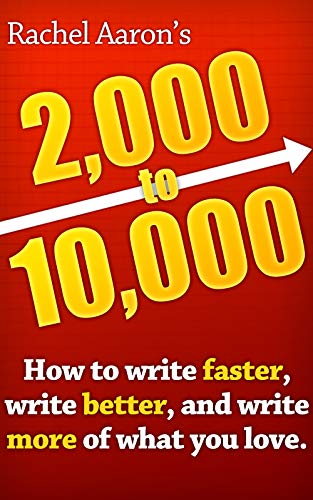
I myself know that I'm capable of writing a book in a short period of time, because I've done it--I wrote In Search of the Magic Theater in three months, during which time I was also completing my PhD and teaching. Admittedly, that's not counting the fact that I first had the idea for it about ten years before I wrote it, and that I'd written a few pages some years prior to writing the whole book. In other words, I had thought about it some ahead of time--but not really very much, because I was in grad school for most of that period and there wasn't much mental space for either reading or writing fiction until I was close to graduation. So the fact that I wrote nearly every word of an entire and publishable novel in three months remains a fairly impressive thing. Years earlier I had written my first finished novel in about the same length of time, a murder mystery that I don't anticipate revising or seeking a publisher for. And in 2019 I wrote another novel in three months, followed by a novella in 2020 that took about the same amount of time. I wrote these three-month novels with a general goal of averaging 2000 words per day, which for me is not a difficult goal if I have a clear idea where I'm going.
Most of my book projects, however, are taking much longer. As in ten years or more. I completed one of those ten-year books in 2019 and have three others that I like to think I could finish if I had a good chunk of time for each. As in, maybe finish one each summer if my teaching and research don't get in the way. (After finishing my novella, I would have liked to finish one of the novels, but the rest of the summer went toward figuring out how to teach remotely in the pandemic, including creating a new course.)
One of the major pieces of advice for writers, at least in the academic world (but true for any writing), is Ass In Chair. Namely, you can't get writing done if you don't settle down and do it. Obvious, but especially important for those who don't enjoy writing, and many scholars don't. Even many fiction writers don't enjoy the writing itself particularly; they enjoy having written. However, I think most fiction writers do enjoy writing, at least much of the time. Why else would we do it?
My colleague Erin Flanagan over in the English department, who teaches novel and short story writing, found an interesting blog post about increasing our productivity, which I offer to you all, fiction or nonfiction writers of any sort. Rachel Aaron, also published as Rachel Bach, writes genre fiction series, so she has more deadlines than some of us do. She wasn't having much trouble managing 2000 words per day, but as a newly full-time writer with a series to write, she wanted to increase her productivity. After all, if she could write 2000 words a day before going to her job, couldn't she write 4000 words a day as a full-time writer?
At first she couldn't. And here I'd jump in to say that in my experience, writing a lot is something that, much like doing pushups or running marathons, you gradually work up to being able to do. Yes, you have to settle down to work, but at first you probably have to write in short increments and then build up how long you can work without getting frustrated or distracted.
Rachel says, "I gathered data and tried experiments, and ultimately ended up boosting my word count to heights far beyond what I'd thought was possible, and I did it while making my writing better than ever before." She began keeping records: "Every day I had a writing session I would note the time I started, the time I stopped, how many words I wrote, and where I was writing on a spreadsheet. I did this for two months, and then I looked for patterns." She discovered where she was most productive (for her, in a cafe with no wifi), and that if she had more than an hour available, she wrote more per hour than if she only had one hour to write (but that beyond seven hours, productivity dropped again). She also found the time of day that she was most productive, which was not the time she thought it would be.
This is something every writer can try--seeing when we are, individually, most productive and then making the best of that time. But Rachel also found two other major factors that improved her productivity. One, in fact, she discovered prior to studying when she was productive. This was to have a good idea in advance where she was going with a scene.
"I wasn't a total make-it-up-as-you-go writer. I had a general plot outline, but my scene notes were things like 'Miranda and Banage argue' or 'Eli steals the king.'" She knew the general direction and liked to let the characters take control. However, "this meant I wasted a lot of time rewriting and backtracking when the scene veered off course." She noted, "Here I was, desperate for time, floundering in a scene, and yet I was doing the hardest work of writing (figuring out exactly what needs to happen to move the scene forward in the most dramatic and exciting way) in the most time consuming way possible (ie, in the middle of the writing itself)."
Instead, Rachel began her writing sessions by jotting down notes about the scene she was about to write: "working out the back and forth exchanges of an argument between characters, blocking out fights, writing up fast descriptions." She says, "Every writing session after this realization, I dedicated five minutes (sometimes more, never less) and wrote out a quick description of what I was going to write. Sometimes it wasn't even a paragraph, just a list of this happens then this then this." This saved her from writing lots of text that went in the wrong direction and had to be cut or rewritten later.
This is not something I myself typically do when writing fiction. For one thing, I'm not usually (other than that mystery novel long ago) writing genre fiction. My characters don't usually have arguments or lots of dramatic action; often what goes on is more internal, and while I do a certain amount of productive, written speculation about what I might want to have happen, most of my best ideas happen in the course of actually writing. But while I don't usually have to do heavy revision of the kind many writers rely on (cutting scenes, turning two characters into one, changing point of view), I'm aware that my "quick" novels get written in a different manner, closer to what Rachel does, than my ten-year novels. My quick novels have more of a structure from the outset and I usually write them starting at the beginning and in the order of the chapters, ending with the end. My ten-year novels do have a structure from the outset, but it's a more open, fluid one. They're more likely to be a Bildungsroman, or some other less plot-driven form. My scenes aren't written in any particular order, I just will have an idea for a scene and know it goes somewhere in the middle. Gradually the scenes accrete and their order and transitions get worked out.
So although I'd like to write more of my novels more quickly, I'm not sure whether Rachel's advice about starting the writing session with quick notes will always work for me, but it should work for at least some of what I write, and should certainly help writers who like to outline in advance to some extent.
Rachel's third breakthrough was about enthusiasm. "Those days I broke 10k were the days I was writing scenes I'd been dying to write since I planned the book. ... By contrast, my slow days (days where I was struggling to break 5k) corresponded to the scenes I wasn't that crazy about." She began to focus on figuring out how to either get rid of the scenes that excited her less, or make them more interesting.
Again, since I write a different kind of fiction than Rachel, this isn't quite what I struggle with, but I have a parallel situation. The scenes that I put off writing aren't those that I find dull, really, but are more often those that I don't feel I know how to write yet--that I haven't researched something enough, or where I'm unsure how to do a transition. When wrapping up the ten-year novel that I finished in 2019, this kind of thing was my main focus, and often I found I could handle the problem by simply writing a few lines, a summary of what I wanted to say, and that was enough. Not every scene or transition needs to be fleshed out in detail.
What Rachel does not count here is the time spent plotting the novel and figuring out its overall shape. It's clear that she does this prior to writing the chapters, and this is something that can take significant amounts of time. I know I often think about a novel idea for years before I feel ready to start, even though I may not have more than a vague idea of the structure by the time I start. For me, having several simultaneous projects means that when I'm not focused on one in particular (writing that quick novel or finishing a ten-year novel), I'm never stuck because I can always work on a different project. I'm always curious how other writers structure their work and I'm not above stealing basic structures and plots.
Rachel says, finally, "There are many fine, successful writers out there who equate writing quickly with being a hack. I firmly disagree. My methods remove the dross, the time spent tooling around lost in your daily writing, not the time spent making plot decisions or word choices. This is not a choice between ruminating on art or churning out the novels for gross commercialism (though I happen to like commercial novels), it's about not wasting your time for whatever sort of novels you want to write." I agree with her. While I don't think all novels can be written quickly, I'm all for writing more efficiently.
After blogging about writing more productively, Rachel went on to write a book about her method, 2000 to 10,000: How to Write Better, Write Faster, and Write More of What You Love, which you can buy on Amazon for Kindle at a very reasonable price.
Thursday, April 2, 2020
Thoughts About Dialogue Tags
A cousin of mine recently, in an email exchange about writing, asserted "Remember: no adverbs in the retort. ‘Said,’ is good enough." To which I replied, "That's overdoing it. Nothing wrong with 'replied gleefully' now and then.
I was reminded of this when I happened to read the blog post What Your Choice of Dialogue Tags Says About You, by Christopher Hoffmann. Hoffmann tends in my cousin's direction, but with nuances, some of which are very entertainingly presented. First he points out that in our daily speech, we normally say that someone "said" something, not that they "remarked" or "answered" or "hollered" or whatnot. He also notes that people of a certain age use "like" for "said," as in "I'm like, 'Wow, you really mean that?'" Personally, I never interpreted this to mean that the person actually said whatever it was, but rather that that was how they felt about it, but I could be wrong about that. (Incidentally, I can assure Hoffmann that people born before 1970 have spoken in this manner, because it was common parlance when I was in college, back in prehistoric times.)
Hoffmann then tells us that people who want their writing to be considered literary scorn the use of anything more colorful than "said" because, as so many books on writing prescribe, one must "show, not tell." If you have to say that someone ranted, evidently you haven't made the actual speech rant-y (rantish?) enough for the reader to discern that the person was ranting rather than stating, musing, joking, or remarking superciliously. Well, I'll confess that in my youth (that is, around the age of twelve) I believed this hoopla about "show, don't tell" and it was deleterious to my writing because I assumed you had to show everything and tell nothing, which made for masses of laborious dreck. Fortunately I could not bear to keep up the effort to show and not tell, and in truth, the very best fiction is full of telling as well as showing. And, as Hoffmann admits later on, sometimes you really need to tell the reader that the character is ranting rather than merely blabbing on endlessly in a mild sort of way. But he suggests that it is only in commercial and genre fiction that one can get away with deviating from "said."
I agree with Hoffmann that it is generally preferable to use more colorful dialogue tags as spice, but I am curious whether the literary writing to which he makes reference is the stripped-down bare-bones Raymond Carver style that was so popular in the '80s, or if this is still prescribed in the MFA programs of today. While I do read recent literary fiction, the fact that I don't teach fiction writing frees me from feeling obliged to keep up with all the latest trends, just as the fact that I specialize in Czech modernism rather than American contemporary art frees me from being obsessively au courant about the New York gallery scene.
Subscribe to:
Posts (Atom)