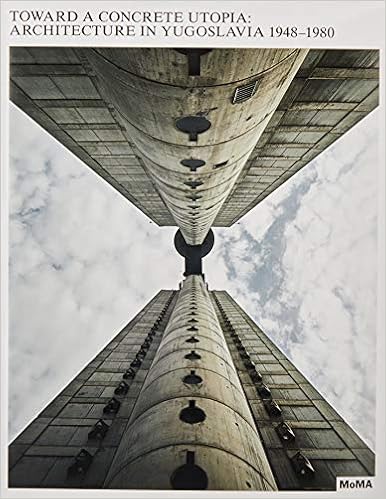
Not precisely a new book at this point, but Toward a Concrete Utopia: Architecture in Yugoslavia, 1948–1980, edited by Martino Stierli and Vladimir Kulić, was just awarded the Society of Architectural Historians 2021 Exhibition Catalogue Award. Kudos to the editors and authors!
I regret to say it looks like this is no longer available from MOMA's design shop, but you can still get it on Amazon (for a high price).
Showing posts with label architecture. Show all posts
Friday, April 16, 2021
Friday, January 15, 2021
Open Plan: A Design History of the American Office
Another intriguing book by a scholar of my acquaintance is Open Plan: A Design History of the American Office, by Jennifer Kaufmann-Buehler. Jennifer is a design historian and has long been fascinated by the utopian but now-despised open office. She " traces the history and evolution of the American open plan from the brightly-colored office landscapes of the 1960s and 1970s to the monochromatic cubicles of the 1980s and 1990s," and analyzes both the original architectural intentions and how workers have actually experienced these spaces. (I can affirm that working in a gray cubicle during much of my early adulthood was not a pleasant experience.)
I love her book cover! You can read more about the book and order it here.
Friday, December 18, 2020
New Journal Founded: Art East/Central
Art East/Central is a new English-language, open access, peer-reviewed journal that will publish original articles on architecture, design and the visual arts in Central and East-Central Europe 1800 to the present. It will also feature book and exhibition reviews, reports, and occasional discussion forums. An international editorial board and a rigorous, double-blind peer review process are intended to ensure the high quality and originality of the contents.
"We welcome your submissions to be considered for future issues at journal@arteastcentral.eu. We are particularly interested in contributions that adopt a transnational approach, examining practices, ideas and traditions that cross the political, linguistic, ethnic, and cultural boundaries of the region. Interdisciplinary approaches, as well as reflection on the particular challenges this region raises for relevant academic practices, are also encouraged. Submissions from graduate students are welcome."
Published by CRAACE (CONTINUITY/RUPTURE: ART AND ARCHITECTURE IN CENTRAL EUROPE 1918-1939), the first issue is expected to be out in early 2021. Check here to find it.
Sunday, July 28, 2019
Prague: Crossroads of Europe
Derek Sayer. Prague: Crossroads of Europe. London: Reaktion Books, 2019. 280 pp. $22.00 (cloth), ISBN 978-1-78914-009-5.
Reviewed by Karla Huebner (Wright State University)
In the years since the Velvet Revolution, Prague—for forty years a near-mystery behind the Iron Curtain—has become one of Europe’s most visited cities. Praised in the early 1990s as an expat destination rivaling Paris of the 1920s, then infested in the 2000s by drunken British stag parties, Prague has nonetheless remained a site too little understood by most of its visitors, many of whom have very little awareness of its complex history.
Derek Sayer’s Prague: Crossroads of Europe should help travelers gain a fuller and more nuanced understanding of the city and its context. Part of Reaktion’s Cityscapes series (other titles address Beijing, Berlin, Buenos Aires, Chicago, New York, Paris, and San Francisco), it combines history with travel guide. Titles in this series are written “by authors with intimate knowledge of the cities,” provide “a unique overview of a city’s past as well as a focused eye on its present,” and offer “essential cultural companions to the world’s greatest cities.” To accomplish this, the usual travel-guide format is reversed: instead of a short overview of the city followed by endless listings of sights, lodgings, restaurants, and shops, here we have 226 illustrated pages of urban and national history followed by twenty pages of listings, five pages of chronology, fifteen pages of citations for quoted material and additional sources, two pages of suggested reading and viewing, and a ten-page index.
As a scholar who often writes about Prague and the Czech lands (notably, the prize-winning books The Coasts of Bohemia: A Czech History [1998] and Prague, Capital of the Twentieth Century: A Surrealist History [2013]), Sayer is an appropriately knowledgeable author for this title. His background as a sociologist, combined with decades of research on Czech cultural history, gives him an unusually broad basis from which to prepare a guide for the intelligent, nonspecialist traveler. He writes in an accessible, jargon-free style and has a fine eye for the telling detail and illuminating anecdote.
But as this book is a travel guide, we may reasonably ask whether it is useful beyond that specific purpose. What does it offer scholars of urban history, or for that matter scholars in general who may or may not be planning trips to Prague?
Prague: Crossroads of Europe is, actually, a worthwhile addition to the urban historian’s library. While it is not conceived as an analytical text and (unsurprisingly) does not offer detailed accounts of population shifts, annexations of suburbs, construction of sewers, waterworks, or electrical grids, nor maps of the city’s growth, fortifications, or metro, Sayer is nonetheless alert to such matters and weaves them into his text. The meat of the book consists of an informative prologue, twelve chapters of history, and seven essays about aspects of the city today. The twelve historical chapters take us from the legendary birth of the city up to a brief look at the Velvet Revolution and its aftermath.
Against this larger backdrop of the history of Bohemia and Moravia (necessary to properly understand the history of Prague), much material of interest to the urban historian can be found. For instance, the second chapter, “Přemyslid Prague,” overviews developments from the ninth through the thirteenth century, with information on the establishment of churches, monasteries, and synagogues, as well as notes on markets, bridges, fortifications, and flooding. This chapter also points out that with a population estimated at around 3,500 in 1200, Jews, Germans, and Italians as well as Czechs were part of the city from very early (Prague’s first pogrom occurred in 1096 and the earliest mention of a synagogue dates to 1124). In chapter 3, “The Golden Age of Charles IV,” Sayer focuses on urban developments under the celebrated fourteenth-century ruler, such as street paving, contracts for street cleaning and waste disposal in 1340, the foundation of Charles University, and ethnic and social differences between Old Town and New Town. Chapter 4, “Against All!” gives background on the fourteenth and fifteenth centuries, during which religious conflict was particularly significant for the city and for Bohemia more generally. Chapter 5, “A Poisoned Chalice,” similarly highlights religious conflict during the fifteenth and sixteenth centuries, but also provides information on architectural changes, such as work on the Old Town Hall and New Town Hall, the foundation of the Jesuit Clementinum (now the National Library), Renaissance additions to the Lesser Town and elsewhere, the flourishing Jewish community of the turn of the seventeenth century, and Emperor Rudolf’s proclamations against dirty streets and rising crime. Chapter 6, “The White Mountain,” looks at seventeenth- and eighteenth-century developments, many of which relate to the re-Catholicization of the city after the Battle of White Mountain in 1620, such as the expulsion of non-Catholic clergy and “the choice of conversion or banishment” for nobles and burghers (p. 88). The shift to German as language of state, literature and learning, and polite society, and the devastations of the Thirty Years War and plague are also noted, as well as the baroque construction boom, which involved the building of numerous churches, aristocratic palaces, and burgher townhouses; information on the subsequent lives of many of these buildings is provided as well.
Chapter 7, “The Homeland and the Muses,” moves on to the Enlightenment, with the beginnings of religious toleration; the rise in land patriotism (versus linguistic/ethnic nationalism); the establishment of purpose-built theaters; and the construction of highways, sewers, paved streets, parks, and bridges and embankments, not to mention the arrival of industrialization. Chapter 8, “Golden Slavonic Prague,” addresses the nineteenth-century growth in population and Czech nationalism, with attention to census self-identification and linguistic geography in the city, as well as rising Czech-language education, literature, and societies. The continued growth of industry; the departure of Jews from the ghetto and slum clearance there; the construction of railways, bridges, waterworks, the Negrelli Viaduct, and also the city’s first gasworks, electric lighting, and telephone network as well as major public buildings, a stock exchange, and important new churches; and the rise of art nouveau architecture are also outlined. Chapter 9, “At the Crossroads,” focuses on the First Republic (1918-38) and the establishment of Greater Prague, which annexed thirty-eight largely Czech suburbs to the city, shifting its demographics; the retitling of German and Habsburg place names is also mentioned. The contributions of modernist architects are noted, as are developments in industry, transit, social housing, garden city suburbs, department stores, and traffic lights. Chapter 10, “Into the Shadows,” covers the Nazi occupation of 1938-45, extermination of the Jews, and the postwar expulsion of ethnic Germans. Chapter 11, “Prague Moves East,” addresses the city under Communism and includes discussion of monuments; the massive construction of suburban prefab housing; the development of the metro and other improvements in transportation; the construction of Stalinist and Brutalist hotels, department stores, theaters, and the TV tower; and efforts relating to architectural conservation. Chapter 12, “Back into Europe,” primarily summarizes the Velvet Revolution, then mentions a few aspects of the shift back to capitalism.
The section “The City Today” provides essays on the Prague coffee house, beer, Cubism, modernity, the Karlín district, Little Hanoi, and the Dancing House. These provide looks at aspects of the present-day city that include much political, ethnic, artistic, literary, and historical information. They do not attempt to give an account of the entire metropolitan area, but rather use specific topics to convey important aspects of the city that include which cafes were frequented by particular famous figures, and the relationship between traditional pubs and wine bars to the likes of new Irish pubs and craft brewing. Czech modernist architecture from Cubism to Functionalism benefits from two essays; changes in neighborhoods are the topic of “Karlín Redux” (gentrification from a working-class and Roma district to a yuppie and hipster enclave); “Little Hanoi” addresses the city’s large Vietnamese population by introducing the reader to a huge market complex on the southern outskirts and the voices of some Vietnamese Praguers. The Dancing House essay looks at recent Czech-Western interconnections such as Frank Gehry and Vlado Miluniċ’s famous “Fred and Ginger” plus rock music and Prague anglophone literature.
While Prague: Crossroads of Europe is not a substitute for a scholarly text on the urban history of Prague, overall it provides a remarkably useful and very readable short history that will certainly be welcomed by scholars visiting the city; it can also be used as a quick reference. Sayer sprinkles information about numerous historical periods and topics into his chapters, which makes for a more engaging read but means the index is vital for readers who want to know specifics about particular structures or topics. Also, while quotations are cited and general sources are given, scholarly readers will have to hunt for sources of some of the information (such as data on street paving or electrification). Here, additional “Further Reading” titles would have been helpful. But so long as the reader recognizes the overarching purpose of the book, which is to give the traveler a historically focused introduction to the city, scholars as well as the general public should find this a worthy volume. In fact, it could also serve as a textbook for a course on the city, if supplemented with suitable additional readings.
Originally published at H-Urban, H-Net Reviews, July, 2019, under a Creative Commons Attribution-Noncommercial-No Derivative Works 3.0 United States License.
Reviewed by Karla Huebner (Wright State University)
In the years since the Velvet Revolution, Prague—for forty years a near-mystery behind the Iron Curtain—has become one of Europe’s most visited cities. Praised in the early 1990s as an expat destination rivaling Paris of the 1920s, then infested in the 2000s by drunken British stag parties, Prague has nonetheless remained a site too little understood by most of its visitors, many of whom have very little awareness of its complex history.
Derek Sayer’s Prague: Crossroads of Europe should help travelers gain a fuller and more nuanced understanding of the city and its context. Part of Reaktion’s Cityscapes series (other titles address Beijing, Berlin, Buenos Aires, Chicago, New York, Paris, and San Francisco), it combines history with travel guide. Titles in this series are written “by authors with intimate knowledge of the cities,” provide “a unique overview of a city’s past as well as a focused eye on its present,” and offer “essential cultural companions to the world’s greatest cities.” To accomplish this, the usual travel-guide format is reversed: instead of a short overview of the city followed by endless listings of sights, lodgings, restaurants, and shops, here we have 226 illustrated pages of urban and national history followed by twenty pages of listings, five pages of chronology, fifteen pages of citations for quoted material and additional sources, two pages of suggested reading and viewing, and a ten-page index.
As a scholar who often writes about Prague and the Czech lands (notably, the prize-winning books The Coasts of Bohemia: A Czech History [1998] and Prague, Capital of the Twentieth Century: A Surrealist History [2013]), Sayer is an appropriately knowledgeable author for this title. His background as a sociologist, combined with decades of research on Czech cultural history, gives him an unusually broad basis from which to prepare a guide for the intelligent, nonspecialist traveler. He writes in an accessible, jargon-free style and has a fine eye for the telling detail and illuminating anecdote.
But as this book is a travel guide, we may reasonably ask whether it is useful beyond that specific purpose. What does it offer scholars of urban history, or for that matter scholars in general who may or may not be planning trips to Prague?
Prague: Crossroads of Europe is, actually, a worthwhile addition to the urban historian’s library. While it is not conceived as an analytical text and (unsurprisingly) does not offer detailed accounts of population shifts, annexations of suburbs, construction of sewers, waterworks, or electrical grids, nor maps of the city’s growth, fortifications, or metro, Sayer is nonetheless alert to such matters and weaves them into his text. The meat of the book consists of an informative prologue, twelve chapters of history, and seven essays about aspects of the city today. The twelve historical chapters take us from the legendary birth of the city up to a brief look at the Velvet Revolution and its aftermath.
Against this larger backdrop of the history of Bohemia and Moravia (necessary to properly understand the history of Prague), much material of interest to the urban historian can be found. For instance, the second chapter, “Přemyslid Prague,” overviews developments from the ninth through the thirteenth century, with information on the establishment of churches, monasteries, and synagogues, as well as notes on markets, bridges, fortifications, and flooding. This chapter also points out that with a population estimated at around 3,500 in 1200, Jews, Germans, and Italians as well as Czechs were part of the city from very early (Prague’s first pogrom occurred in 1096 and the earliest mention of a synagogue dates to 1124). In chapter 3, “The Golden Age of Charles IV,” Sayer focuses on urban developments under the celebrated fourteenth-century ruler, such as street paving, contracts for street cleaning and waste disposal in 1340, the foundation of Charles University, and ethnic and social differences between Old Town and New Town. Chapter 4, “Against All!” gives background on the fourteenth and fifteenth centuries, during which religious conflict was particularly significant for the city and for Bohemia more generally. Chapter 5, “A Poisoned Chalice,” similarly highlights religious conflict during the fifteenth and sixteenth centuries, but also provides information on architectural changes, such as work on the Old Town Hall and New Town Hall, the foundation of the Jesuit Clementinum (now the National Library), Renaissance additions to the Lesser Town and elsewhere, the flourishing Jewish community of the turn of the seventeenth century, and Emperor Rudolf’s proclamations against dirty streets and rising crime. Chapter 6, “The White Mountain,” looks at seventeenth- and eighteenth-century developments, many of which relate to the re-Catholicization of the city after the Battle of White Mountain in 1620, such as the expulsion of non-Catholic clergy and “the choice of conversion or banishment” for nobles and burghers (p. 88). The shift to German as language of state, literature and learning, and polite society, and the devastations of the Thirty Years War and plague are also noted, as well as the baroque construction boom, which involved the building of numerous churches, aristocratic palaces, and burgher townhouses; information on the subsequent lives of many of these buildings is provided as well.
Chapter 7, “The Homeland and the Muses,” moves on to the Enlightenment, with the beginnings of religious toleration; the rise in land patriotism (versus linguistic/ethnic nationalism); the establishment of purpose-built theaters; and the construction of highways, sewers, paved streets, parks, and bridges and embankments, not to mention the arrival of industrialization. Chapter 8, “Golden Slavonic Prague,” addresses the nineteenth-century growth in population and Czech nationalism, with attention to census self-identification and linguistic geography in the city, as well as rising Czech-language education, literature, and societies. The continued growth of industry; the departure of Jews from the ghetto and slum clearance there; the construction of railways, bridges, waterworks, the Negrelli Viaduct, and also the city’s first gasworks, electric lighting, and telephone network as well as major public buildings, a stock exchange, and important new churches; and the rise of art nouveau architecture are also outlined. Chapter 9, “At the Crossroads,” focuses on the First Republic (1918-38) and the establishment of Greater Prague, which annexed thirty-eight largely Czech suburbs to the city, shifting its demographics; the retitling of German and Habsburg place names is also mentioned. The contributions of modernist architects are noted, as are developments in industry, transit, social housing, garden city suburbs, department stores, and traffic lights. Chapter 10, “Into the Shadows,” covers the Nazi occupation of 1938-45, extermination of the Jews, and the postwar expulsion of ethnic Germans. Chapter 11, “Prague Moves East,” addresses the city under Communism and includes discussion of monuments; the massive construction of suburban prefab housing; the development of the metro and other improvements in transportation; the construction of Stalinist and Brutalist hotels, department stores, theaters, and the TV tower; and efforts relating to architectural conservation. Chapter 12, “Back into Europe,” primarily summarizes the Velvet Revolution, then mentions a few aspects of the shift back to capitalism.
The section “The City Today” provides essays on the Prague coffee house, beer, Cubism, modernity, the Karlín district, Little Hanoi, and the Dancing House. These provide looks at aspects of the present-day city that include much political, ethnic, artistic, literary, and historical information. They do not attempt to give an account of the entire metropolitan area, but rather use specific topics to convey important aspects of the city that include which cafes were frequented by particular famous figures, and the relationship between traditional pubs and wine bars to the likes of new Irish pubs and craft brewing. Czech modernist architecture from Cubism to Functionalism benefits from two essays; changes in neighborhoods are the topic of “Karlín Redux” (gentrification from a working-class and Roma district to a yuppie and hipster enclave); “Little Hanoi” addresses the city’s large Vietnamese population by introducing the reader to a huge market complex on the southern outskirts and the voices of some Vietnamese Praguers. The Dancing House essay looks at recent Czech-Western interconnections such as Frank Gehry and Vlado Miluniċ’s famous “Fred and Ginger” plus rock music and Prague anglophone literature.
While Prague: Crossroads of Europe is not a substitute for a scholarly text on the urban history of Prague, overall it provides a remarkably useful and very readable short history that will certainly be welcomed by scholars visiting the city; it can also be used as a quick reference. Sayer sprinkles information about numerous historical periods and topics into his chapters, which makes for a more engaging read but means the index is vital for readers who want to know specifics about particular structures or topics. Also, while quotations are cited and general sources are given, scholarly readers will have to hunt for sources of some of the information (such as data on street paving or electrification). Here, additional “Further Reading” titles would have been helpful. But so long as the reader recognizes the overarching purpose of the book, which is to give the traveler a historically focused introduction to the city, scholars as well as the general public should find this a worthy volume. In fact, it could also serve as a textbook for a course on the city, if supplemented with suitable additional readings.
Originally published at H-Urban, H-Net Reviews, July, 2019, under a Creative Commons Attribution-Noncommercial-No Derivative Works 3.0 United States License.
Labels:
architecture,
art,
book reviews,
books,
Czech,
Prague,
travel
Sunday, May 20, 2018
Moving About a Bit, Starting with Bílá Hora
It had been my hope that this summer I'd be able to rent the same apartment as when I lived in Prague 2005-2007, but regrettably it was not available, so I am instead doing a combination of lodgings. For the first couple of weeks I stayed in a pension out near Bílá Hora, which for those who know Prague will recognize, is on the western fringes of the city. It's at the end of a tram line, in fact.
Why did I choose to lodge way out there? Well, several reasons. First off, it was one of the less expensive options, and that's always a consideration. But secondly, I rather like seeing different parts of Prague. While I'm very fond of my old apartment near the Dvorce tram stop in Podolí, which is near a greengrocer's and has good access to a wonderful riverside path (where I learned to rollerblade!), every part of Prague has its merits. Bílá Hora, famous as the site of the historic battle (Bílá Hora/White Mountain) which altered the course of Czech history, is also near Hvězda, a place I'm quite fond of.
Hvězda is not a major tourist attraction, but it's an interesting building, hosts some good small exhibitions generally relating to history, literature, and art (the exhibitions are curated by the Památník národního písemnictví), and there's a large wooded park plus a nice little cafe. It's a great place to go and relax, whether by walking the paths, sitting on a bench under a tree, sunbathing on the lawn, taking in an exhibition, etc.
So, spending a couple of weeks taking the tram back and forth from out there seemed like a pretty attractive notion, and on the whole it worked out just fine.
Saturday, April 7, 2018
Yugoslav World War II Memorials
Another person whose project deserves note is Vladimir Kulić, whose book Bogdanović by Bogdanović: Yugoslav Memorials through the Eyes of their Architect,on Bogdan Bogdanović's photographs of his Yugoslav World War II memorials has received a Graham Foundation grant.
The Graham Foundation states:
Vladimir's book is due out this year. And go see the exhibition at MOMA!
The Graham Foundation states:
The project is an extension of Vladimir Kulić’s previous research on Bogdanović funded by a 2014 Graham Foundation grant, which supported the digitization of Bogdanović‘s personal slide collection. The book will be published by The Museum of Modern Art in New York in conjunction with the forthcoming exhibition Toward a Concrete Utopia: Architecture in Yugoslavia, 1948–1980. In addition to Bogdanović's photos, the book will feature a preface by Martino Stierli, an introductory essay situating the architect's work in the cultural context of postwar Yugoslavia, as well as excerpts from an unpublished interview conducted in 2005–06.I had not previously been aware of the Graham Foundation, as my work doesn't focus on architectural history. "Founded in 1956, the Graham Foundation for Advanced Studies in the Fine Arts fosters the development and exchange of diverse and challenging ideas about architecture and its role in the arts, culture, and society. The Graham realizes this vision through making project-based grants to individuals and organizations and producing exhibitions, events, and publications."
Vladimir's book is due out this year. And go see the exhibition at MOMA!
Labels:
architecture,
art,
books,
friends,
good news,
photography,
Yugoslavia
Subscribe to:
Posts (Atom)


