Prior to World War I, many people enthusiastically envisioned a borderless world—one with unrestricted travel, migration, and trade. International movements for women’s rights and world peace were also strong. Yet reaction was also growing, with strong support for nationalism. There was also recognition that the global economy threatened homegrown and local foods, domestically produced goods, and back-to-the-land communities. The “Spanish flu” heightened anxieties about migration, while the Great Depression intensified demands for economic autonomy. Immigration restrictions and punitive tariffs increased, yet social protections increased, colonialism lost favor, and there were efforts to make the global economy more equitable. Popular revolt against globalization took hold in democracies and dictatorships alike. Tara Zahra’s archival research in five languages will be informative reading for all who seek to understand the anti-global currents of the twentieth century, and today’s battles over international trade, immigration, public health and global inequality.
Showing posts with label academe. Show all posts
Showing posts with label academe. Show all posts
Tuesday, January 24, 2023
Against the World
Historian Tara Zahra's new book Against the World: Anti-Globalism and Mass Politics Between the World Wars is out!
Prior to World War I, many people enthusiastically envisioned a borderless world—one with unrestricted travel, migration, and trade. International movements for women’s rights and world peace were also strong. Yet reaction was also growing, with strong support for nationalism. There was also recognition that the global economy threatened homegrown and local foods, domestically produced goods, and back-to-the-land communities. The “Spanish flu” heightened anxieties about migration, while the Great Depression intensified demands for economic autonomy. Immigration restrictions and punitive tariffs increased, yet social protections increased, colonialism lost favor, and there were efforts to make the global economy more equitable. Popular revolt against globalization took hold in democracies and dictatorships alike. Tara Zahra’s archival research in five languages will be informative reading for all who seek to understand the anti-global currents of the twentieth century, and today’s battles over international trade, immigration, public health and global inequality.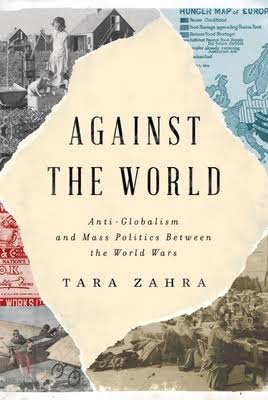
Prior to World War I, many people enthusiastically envisioned a borderless world—one with unrestricted travel, migration, and trade. International movements for women’s rights and world peace were also strong. Yet reaction was also growing, with strong support for nationalism. There was also recognition that the global economy threatened homegrown and local foods, domestically produced goods, and back-to-the-land communities. The “Spanish flu” heightened anxieties about migration, while the Great Depression intensified demands for economic autonomy. Immigration restrictions and punitive tariffs increased, yet social protections increased, colonialism lost favor, and there were efforts to make the global economy more equitable. Popular revolt against globalization took hold in democracies and dictatorships alike. Tara Zahra’s archival research in five languages will be informative reading for all who seek to understand the anti-global currents of the twentieth century, and today’s battles over international trade, immigration, public health and global inequality.

Monday, July 20, 2020
Remind Your Library...
Many libraries--especially college and university libraries--have just begun a new fiscal year and therefore are at the beginning of their annual budget. In other words, it's probably the perfect time to ask your librarian to order Magnetic Woman!
Although we are still in production, libraries (and you too) can pre-order direct from the press.
This is also a great time to request a review copy, should you happen to be a book review editor or a reviewer, and if you think you might be able to use the book in teaching, you can request an exam or desk copy.

Tuesday, July 14, 2020
Course Revision, Ceaseless
It's that time of year when I begin to feel the upcoming school year breathing down my neck. I always find this rather sad, because when I was a student, July and August were lovely vacation months and then once school started (whether in September or in late August) I was always happy to go back.
But of course for those of us who teach, we work pretty much year-round whether or not we teach in the summer. And the latter part of the summer is when things need to be readied for fall.
Now, back when I was on the job market, I envisioned having about three years ahead of intensive course invention, after which I assumed I'd just do some tweaks to existing courses and occasionally create a whole new course on some exciting topic. And this is how it is for many professors. Once they've got their basic set, it's kind of up to them how much to change and when to create something new.
Alas, that's not exactly how my life has gone. While I'm grateful that I got a good job and have congenial colleagues and union faculty and so on, allow me to whine a little, because we all need to kvetch about something or other from time to time.
When I was teaching in grad school, we were on a semester schedule with 15 weeks of class. I created some courses.
I was hired (yay!) but for a quarter schedule. I was also, for the time being, the only person teaching western art, and most of our students took more than six years to graduate. I needed to change all my semester courses to quarter courses and create a lot of new courses.
However, we were also not going to stay on quarters--we were going to switch to a 14-week semester schedule. (Note that previously my semester had been 15 weeks!) After three years of creating quarter courses, I needed to turn them into semester courses. And also make everything taught in the fall go from twice a week to thrice a week, because by that time I wasn't the only person teaching western art and it wouldn't have been fair to make one person teach three times a week all year on the new schedule when the other person got to teach twice a week all year.
The thrice-a-week schedule did not work very well for us because all of the studio courses were twice-a-week (Monday-Wednesday or Tuesday-Thursday), and students, not surprisingly, did not want to come to campus for a 50-minute class on Friday when they had no other reason to be there. So they'd sometimes take three art history courses per semester, which was hard for most of them to handle because the upper-level art history courses are all writing intensive.
We came up with a new plan, which was for both art historians to teach Tuesday-Thursday plus a once-a-week course on Monday or Wednesday. I'm happy with this, so long as I get to choose which course to put in that once-a-week slot. Because not everything works well taught like that. You really need to be able to break up the lecture-and-discussion with films and activities. And so, I've found that this works pretty well for Surrealism and for Modern Design, and tolerably for Women in Art, but it just is not great for Czech Modernism because there are really no films in English on that topic. And note that every time I've taught Czech Modernism I've had to revise the time blocks; Women in Art has also had its time blocks shifted frequently.
After we adopted the Tuesday-Thursday-plus-one schedule, I thought I would finally be able to focus my revisions on making actual improvements to the courses rather than on juggling the time slots, but of course this year we had a whole new problem: COVID-19.
Yep, in the spring I had basically three days to figure out how to take my courses "remote," and now I'm trying to figure out how to more effectively take another one remote for the whole semester plus create my own remote version of a gen-ed course that I've never previously had to teach. Plus, of course, we may need to teach remotely in the spring as well. Hell's bells, for all I know I may need to teach remotely for the rest of my career in higher ed! And I am one of those professors who has always said I would not teach online, because I would rather work face to face with my students.
You can see why I lament and complain. I'm grateful not to be a K-12 teacher who will probably have no choice at all about how to teach in the fall, but still. I'd much rather focus on making my courses better than on simply making sure they can happen at all.
Thursday, March 19, 2020
Closing Down Campus for Safety
We're in our first week of "remote" instruction here and the situation continues to develop. Initially, our university library, computer labs, studios, and offices remained open. But then the library closed (I know our library staff breathed a sigh of relief!), and now pretty much everything on campus is closing as far as I can tell. At any rate, the Art Office, studios, labs...
As for teaching, well, it isn't exactly going all that smoothly for many of us. Those who wanted to put lectures online or even hold synchronous online discussions are reporting some problems. If nothing else, lots of students don't have very reliable internet access or are trying to take care of their kids or elderly parents.
So far, I've tried giving assignments that are fairly open-ended, but I'm having trouble with students (even my one MA student from another department) not reading the instructions very well. When the instructions say that I've put a list of suggested films on our course site, I don't want to have people emailing asking if I can give them a list (but they've done so). When the instructions say to post info about museum web sites on Discussion Board and discuss, I don't want people emailing me or the whole class with what they've found (but they've done so). When I say to watch as many films as they can, I don't want to be asked "how many do you want us to watch?" (but they've done so).
I get that they are feeling discombobulated and stressed out, and I know I don't always pick up key information when I read either. It's just that each unnecessary email of that kind takes time to deal with, makes me worry that a whole lot more are about to arrive, and takes my focus away from grading take-home exams, commenting on actual Discussion Board posts, and planning how to go forward.


Tuesday, March 17, 2020
Face-to-Face Classes Go "Remote"
Last Tuesday, my colleague in Art History and I were making final plans about order of program for the Riess Undergraduate Art History Colloquium, which we were scheduled to host on March 28. The Riess is an annual regional opportunity for art history students (not necessarily majors) to present their work and receive feedback from a small and friendly audience, and we were excited that we'd be hosting the event for the first time.
Alas, it was not to be. No sooner had we gone home to feed our pets before meeting again for a more relaxed supper, than we received word that face-to-face courses would be going "remote" for the rest of March due to the spreading coronavirus pandemic and that events would need to be postponed or cancelled. By the end of the week, the "remote" instruction had been expanded to the remainder of the semester. It's possible we may be able to postpone the Riess until fall, but many of the students may have graduated by then and would not be available.
My university, of course, is by no means the only or even the first in the US to make this move. A growing number of colleges and universities are shifting to "remote," and soon I heard that the annual Czech and Slovak Workshop, which my alma mater the University of Pittsburgh was about to host for the first time, was also not going to occur as scheduled. Like Riess, the Workshop is all about discussion of the participants' research, except that the Workshop has historically been for advanced graduate students and early career scholars with a sprinkling of established scholars.
But events aside, what does "remote" instruction mean? Most faculty have never taught online courses and are not prepared to do so; creating an online course involves a whole lot of work above and beyond that involved in most face-to-face courses.
Expectations for "remote" instruction will vary from school to school, department to department, and course to course. My university has, fortunately, made clear that it need not mean creating the kind of online course that one might do in the normal course of things. After all, students in face-to-face courses did not sign up expecting to have an online education. Not all students have internet at home. Not all students own a computer. (These facts may amaze you, but they are facts, not fake news.) So, expecting everyone to have constant access, and bandwidth for, synchronous lectures and discussion, or what-have-you, is not realistic or fair to less-advantaged students (which means many of my own students). Sure, most students these days do have a smartphone, but I sure would not like to have to expect them to do large amounts of coursework on their phones.
I don't know what my colleagues in studio are doing beyond allowing students to work at home and in our studios (which remain open for now), but we are being allowed a good deal of latitude in figuring out alternate assignments. For now, I've asked my students to watch as many art-related films as they can and write discussion posts about them. This naturally requires some internet access, but I'm not assigning specific films. Our library is still open and so some films can be watched on VHS or DVD. Any art-related films are acceptable (although for each class I've provided a list of options pertinent to the course--good thing I'm not teaching Czech Modernism this semester!), they just need to have enough internet access to discuss what they've seen. Meanwhile, I have an exam to redo to be take-home, a paper assignment to be rewritten since the museum is closed, and so on.
Hoping the pandemic is soon over, but not feeling too optimistic about that for now.
Saturday, February 15, 2020
Moving on from the HGSCEA board
For six years, I've served as an at-large board member of the Historians of German, Scandinavian, and Central European Art. We sponsor an annual panel at College Art Association, throw a nice dinner there for our members, and try to come up with other useful ways of supporting our membership (networking, exhibitions, an article prize for emerging scholars, etc.). It's been a good six years, but as I was recently elected president of the Czechoslovak Studies Association, I need to move on to focusing on that organization's needs.
At this year's HGSCEA meeting, we welcomed several new board members and are pleased to have a mix of new and continuing board members. It looks like the organization is going to have dynamic leadership. And, as a very pleasant surprise, at the annual dinner the outgoing board members all received lovely packages of chocolate from Vosges Chocolates! (I was going to post a photo of the chocolate box, but Google is not cooperating on getting the photo from my phone.)
At this year's HGSCEA meeting, we welcomed several new board members and are pleased to have a mix of new and continuing board members. It looks like the organization is going to have dynamic leadership. And, as a very pleasant surprise, at the annual dinner the outgoing board members all received lovely packages of chocolate from Vosges Chocolates! (I was going to post a photo of the chocolate box, but Google is not cooperating on getting the photo from my phone.)
Wednesday, January 1, 2020
Moving into the 2020s
It's perhaps cliché and obvious to say this, but entering the new decade feels... a bit strange. Not exactly momentous, but peculiar in a way that 2010 didn't. A little more like 2000, but then 2000 was a whole new millennium, so there was widespread excitement and anxiety about that.
Since I particularly study the 1920s and 30s, I may be extra prone to feeling that I don't quite know how to take it being 2020. The days of the flappers don't seem all that distant to me. My grandparents were young and starting their families--both of my parents were born in the 1920s. Toyen and the other Czech avantgardists were in the same generation as my grandparents, although they experienced the period rather differently in Prague than my grandparents did in rural Minnesota. Still, we have photos of one of my grandmothers in short hair and jodhpur-like gear, climbing around some rocks on a California beach. She and Grandpa had driven their car to California and did so more than once, being part of that first generation to have cars almost as a matter of course. Grandpa, in fact, owned a garage for awhile and later a car dealership, in addition to farming; I'm sure he would have been very surprised to learn that his father (gone before his birth) had gone into the car business too, down in Texas.
I suppose it's this odd mix of family lore and scholarly familiarity that renders 2020 rather curious. And so, there's that temptation too to review the past decade and muse about the new one.
In 2010 I was hired tenure-track and bought a house, developments that would have surprised me some had I had a crystal ball in 2000 and that would have seemed utterly unexpected from my 1990 perspective. Academically, things went along in a fairly normal manner for me during the decade--I taught, published, and served on various committees--apart from the fact that in 2019 most of our faculty, myself included, were out on the picket line in the snow for one of the longest higher-education faculty strikes in US history. The support we received from community--students, other unions, non-union faculty, local restaurants, etc.--was impressive and we're eager to return the favor as needed (in the fall I spent some time with the UAW strikers, for instance).
During the 2010s Magnetic Woman was contracted and University of Pittsburgh Press has set a November 2020 launch date. I'm looking forward to putting together some book events to celebrate and promote it! But the 2010s also saw me gradually getting back in gear as a fiction writer, after having neither time nor energy during grad school. While for the most part I worked on novels during that decade, I did get a few short pieces published--one of which had been written thirty-six years earlier. I'm hoping that in the 2020s the speed of publication picks up a bit. It's not like I began publishing late in life; I first published fiction in a respected journal when I was 23.
For the 2020s, I worry about the climate crisis, ecological damage, and the rise of fascistic and racist activity worldwide. But I don't want to focus on that today. There are things each one of us can do (some easy, some hard) to make the world a better place, and I want to do more of those. Maybe I'll write a separate blog post about that. From a personal perspective, though, I'll just say I'm looking forward to seeing Magnetic Woman in print this year and hope to have at least one other book (either a novel or the anthology I've been preparing) accepted this year. And to finish at least one more novel this year. Aim high!
Wednesday, August 7, 2019
Fixing Tenure-Track Hiring
Being that I am, in my day job, a professor, I read a certain number of articles relating to life in academe--all too many of which are fairly depressing. Even if the article isn't depressing, the comments often are. I was mildly skeptical, therefore, that an article entitled 5 Easy Fixes for a Broken Faculty Job Market could possibly offer anything useful.
I'm very pleased to report that this is actually a great and practical article. Whether the fixes are "easy" depends mainly on the extent to which departments choose to apply them.
First, the author recognizes that scholarly job applicants (and indeed search committees) are presently obliged to spend an insane amount of time dealing with job applications. I remember this well from both sides of the game (but especially from the applicant side). When I was on the job market 10+ years ago, we had to send off ridiculous amounts of material, and it usually had to be customized further than just inserting the correct names of school, department, and position in the cover letter. Not that I'm a foe of a good specific cover letter, but that should really be the only thing that has to be customized. In any case, if the author of this article is right, which I assume s/he is (not making any gender assumptions about a first name of Chris), things are worse now than then. When I was applying, for instance, the cover letter was supposed to be no more than two pages, and one was considered somewhat better than two. Now, apparently, the cover letter is expected to be two to four. Egad! That's criminal! Then there is a whole pile of other crap to send--much of which I had to send too, but I never had to send a Diversity Statement, and it wasn't normal to have to send transcripts.
I won't break down everything suggested in the article, but I'm all in favor of knocking the initial application down to just a few pieces, like cover letter, c.v., writing sample or a sample syllabus, and list of references. That's enough for the committee to whittle down to a list of initial interviewees. And while I do prefer in-person interviews, it is unquestionably kinder to applicants to do the first interview by phone, because yes, it costs a lot to go to professional conferences. Yes, people should try to attend for professional development and networking, but not everyone can afford to go when on the job market. Also, while video interviews are now fairly easy to do, my department chair has pointed out that they are not as fair as phone interviews; he had recently had the experience of realizing he was biased against an administrative candidate because he thought her home decor sucked. Obviously, said he, her home decor was irrelevant to whether she could do the job she was interviewing for, and he didn't want to be distracted by that.
Waiting to get references until the middle or final stages of a search also sounds great to me. It is, indeed, a time-sink for references (some of whom write very detailed, individual letters) to write masses of such letters each year. It should be enough to agree to be on someone's reference list and then provide the reference (written or oral) only if the candidate is under serious consideration. (Reference letters for students applying to grad school are a different matter, I think, and should be done at the start. Correct me if I'm wrong.)
There are other important suggestions here too, but even just implementing the above would be a huge step in the right direction. So thank you, Chris M. Golde of Stanford, for making such a practical, kind-to-all set of proposals. Here's hoping they take hold!
Subscribe to:
Posts (Atom)